
Showing posts with label inhibitor. Show all posts
COX-2 inhibitor can prevent "religious headache" during fast

COX-2 inhibitor can prevent "religious headache" during fast

Every year, millions of observant Jews fast on their holiest day, Yom Kippur, and millions of Muslims fast for the month of Ramadan. And every year, as many as 40% of those who fast develop serious headaches.

Yom Kippur headache is a well documented phenomenon but the causes are unclear, but doctors have suspected withdrawal from caffeine, nicotine, oversleeping, and dehydration.

About 36% of subjects who took COX-2 inhibitor etoricoxib (related to Vioxx) developed headaches, compared to about 68% who took placebo. Those who took etoricoxib also had less severe headaches, and they had an easier time fasting.

References:
Could Vioxx cousin prevent religious fast headache? WebMD.
Image source: Etoricoxib, Wikipedia, public domain.
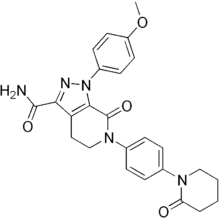
Oral factor Xa inhibitor apixaban - more effective than enoxaparin for thromboprophylaxis after knee replacement

Low-molecular-weight heparins such as enoxaparin are preferred for prevention of venous thromboembolism after major joint replacement. Apixaban, an orally active factor Xa inhibitor, might be as effective, have lower bleeding risk, and be easier to use than is enoxaparin.

The primary outcome in this Lancet study was the composite of asymptomatic and symptomatic deep vein thrombosis (DVT), non-fatal pulmonary embolism (PE), and all-cause death during treatment. The primary outcome was reported in 15% of apixaban patients and 24% of enoxaparin patients (relative risk 0·62), absolute risk reduction 9·3%.

Major or clinically relevant non-major bleeding occurred in 4% of patients receiving apixaban and 5% of treated with enoxaparin.

The authors concluded that apixaban 2·5 mg twice daily, starting on the morning after total knee replacement, offers a convenient and more effective orally administered alternative to 40 mg per day enoxaparin, without increased bleeding.

References:
Image source: Apixaban, Wikipedia, public domain.