Showing posts with label students. Show all posts
Virtual dissection table, stretcher-sized multi-touch screen, a
powerful tool for training medical students

Virtual dissection table, stretcher-sized multi-touch screen, a powerful tool for training medical students

Onstage at TED2012, Jack Choi demonstrates a powerful tool for training medical students: a stretcher-sized multi-touch screen of the human body that lets you explore, dissect and understand the body's parts and systems.

Jack is the CEO of Anatomage, a company specializing in 3D medical technology. See the TED video embedded below:


Comments from Twitter:

Mike Cadogan @sandnsurf: NEED! ...Virtual dissection table, stretcher-sized multi-touch screen bit.ly/IIeko3

Dr Topol to med students: "When I was in medical school, the term "digital" was reserved for the rectal examination"

Here are some excerpts from the Baylor College of Medicine commencement address by Dr. Eric Topol, director of the Scripps Translational Science Institute, delivered yesterday, May 22, 2012. This should be a required reading for everyone involved in healthcare, which is basically everybody because each and every one of us will be a patient one day.

Eric Topol to medical students: "When I was in medical school, the term "digital" was reserved for the rectal examination."

"You sleep with your cell phone and prize it right up there with food and water. We have evolved to a new species of man. We are Homo distractus!"

The benefits of digital medicine are clear to Dr. Topol who shares the story of a patient he saw last week: "I asked him to put his fingers on the 2 sensors on the back of my iPhone case so I could do his electrocardiogram—ECG—that was normal. And free, by the way. Then instead of using a stethoscope to listen to his heart, I used a portable pocket-sized high-resolution ultrasound device and within a minute I could see every heart structure—the heart muscle thickness and function, the valves, the size of the 4 chambers. Why would I ever listen for lub-dub when I can see everything? I haven't used a stethoscope for over 2 years to listen to a patient's heart."

From Baylor College of Medicine (BCM) YouTube channel: 2012 Commencement Speaker, Dr. Eric Topol, spoke on May 21, 2012:


Here is Eric Topol's presentation at Health at Google:


References:

Baylor College of Medicine commencement address by Dr. Eric Topol, director of the Scripps Translational Science Institute

Comments from Twitter

Quoc-Dien Trinh, MD @qdtrinh: Makes it sound cool. “@DrVes: Dr Topol to med studs: When I was in med school, the term "digital" was reserved for the rectal examination"
$295,000 In Medical School Debt... Why do medical schools charge
students so much money?

$295,000 In Medical School Debt... Why do medical schools charge students so much money?

Rob Centor:

"Why do medical schools charge students so much money? It was not this way when I went to medical school. I paid an average of $1000 per year in the early 1970s.

Using an inflation calculator, that would become around $5000 per year in current dollars. Yet that same school and most state schools charge 3 times that much."

References:
http://www.huffingtonpost.com/2010/02/23/295000-in-medical-school_n_473601.html
http://www.medrants.com/archives/5327
Image source: OpenClipArt.org, public domain.
Standardized patient: Over the course of three days, I had 23
head-to-toe physicals from 23 medical students

Standardized patient: Over the course of three days, I had 23 head-to-toe physicals from 23 medical students

From Slate:

"I was the first person these would-be doctors had ever fully examined on their own. Some were shaking so violently when they approached me with their otoscopes—the pointed device for looking in the ear—that I feared an imminent lobotomy.

A "standardized patient" is a trained person who is paid $15 an hour to be poked and prodded by inexperienced fingers, so that med students can learn communication and examination skills before they are sicced on actual sick people.

Now there are standardized patients trained for genital duty (they're called GUTAs, for genitourinary teaching associates).

Dr. N wasted the first eight minutes of the exam trying repeatedly to get a blood pressure reading. The panic in his eyes seemed to say, "She appears to be alive, yet she has no vital signs."

Comments:

Lakshman Swamy - Don't forget that some of them were capable! I have to say, in my experience as an MS2 at Wright State, our standardized patients are amazing teachers. It is much easier to learn physical exam skills and even interviewing when the patient can give you precise feedback. The author is right on with the characters that patients can portray... it is shocking when they break character to give feedback! Just recently I learned how to do the male exam with two standardized patients ("GUTA" -- never heard of that term before). I was definitely feeling a little ... awkward before the session began-- this was by far the most invasive thing I had ever done to another person. But the standardized patients were amazing about the whole process, even acting out the different hesitations that we might encounter in patients, emphasizing the importance of the exam, etc. Without being too graphic, I can't emphasize how much I learned about how to do those exams and what I was actually supposed to be finding. It was a totally different experience than I expected, and after it, I feel really confident about the whole process.

I can't even IMAGINE what it would be like to do that with my classmates-- and how much less I would have understood. Wow.

References:
Oh, no! I'm the first patient these 23 medical students have ever examined. Slate, 2010.
Image source: OpenClipArt.org, public domain.

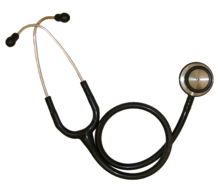
500 repetitions of 4 cardiac murmurs improved auscultatory proficiency of medical students

According to a 2004 study in Chest, the ability of medical students to recognize heart murmurs is poor (20%), and does not improve with subsequent years of training.

Five hundred repetitions of four basic cardiac murmurs significantly improved auscultatory proficiency in recognizing basic cardiac murmurs by medical students. These results suggest that cardiac auscultation is, in part, a technical skill.

Related resources

The Heart Sounds Tutorial by Blaufuss.org is a fancy flash-based simulator with animations. The McGill University Virtual Stethoscope is another useful website. Click here for more web-based teaching resources for hearts sounds from UCLA and breath sounds from Loyola University.

References:
Mastering cardiac murmurs: the power of repetition. Barrett MJ, Lacey CS, Sekara AE, Linden EA, Gracely EJ. Chest. 2004 Aug;126(2):470-5.
http://www.ncbi.nlm.nih.gov/pubmed/15302733
Image source: Modern stethoscope. Wikipedia, public domain.

Physically fit students score higher on tests than their less fit peers

Test scores dropped more than one point for each extra minute it took middle and high school students to complete a 1-mile run/walk fitness test.

65% of the students were below the state fitness standard. Compared with these students, students who met or exceeded fitness standards had higher average test scores. Overweight and obese students also scored significantly lower on tests.

Schools may have to reverse their recent disinvestment in physical education ostensibly for the purposes of boosting student achievement.

Exercise slows telomere shortening (and aging). Telomeres are the chromosome tips which shorten each time a cell divides, making them a possible marker of aging. A study of 2400 twins showed that physically active people had longer telomeres than sedentary people.


Human chromosomes (grey) capped by telomeres (white). Image source: Wikipedia, public
domain.

If you need any more convincing, please see this "health promotion" video that clearly shows the benefits of exercise:


"Health Promotion" video: Benefits of exercise.

Participation in sport is associated with a with a 20—40% reduction in all-cause mortality compared with non-participation. Exercise might also be considered as a fifth vital sign, according to the Lancet: http://goo.gl/gyxYf

References:
Physical, academic fitness tied at the hip: study. Reuters, 2010.
The Journal of Pediatrics, published online January 25, 2010.

How to identify medical students at risk of subsequent misconduct?

This small BMJ study suggests the following risk factors for subsequent professional misconduct:

- male sex
- lower socioeconomic background
- early academic difficulties at medical school

59 doctors who had graduated from 8 medical schools in the United Kingdom in 1958-97 and had a proved finding of serious professional misconduct in 1999-2004 (cases) and 236 controls (four for each case) were included in the study.

The findings are preliminary and should be interpreted with caution. Most doctors with risk factors will not come before disciplinary panels.

References:
Image source: OpenClipArt.org (public domain).

25% of medical students use Facebook for education - with mixed success

This Australian study aimed to evaluate how effectively medical students may be using Facebook for education.

Researchers surveyed 759 medical students at one Melbourne university, and explored the design and conduct of 4 Facebook study groups.

25.5% of students reported using Facebook for education-related reasons and another 50.0% said they were open to doing so.

The case studies showed conservative approaches in students' efforts to support their development of medical knowledge and mixed successes.

The study authors concluded that Facebook as part of learning and teaching is as much of a challenge for many students as it may be for most educators.

References:
Medical students' use of Facebook to support learning: Insights from four case studies. Gray K, Annabell L, Kennedy G. Med Teach. 2010;32(12):971-6.
Assistant professor uses Twitter to teach students dental anatomy at Ohio State University - 113 of 200 students signed up, 56% http://goo.gl/jvyq7
Blogs read by 20% of UK medical students, but only 8% write their own

Blogs read by 20% of UK medical students, but only 8% write their own

A wide range of social media tools has become readily available in recent years, to the extent that the use of Facebook in particular is perceived as "second nature" by many students. There is increasing interest in the possibilities of using this social media services for medical education - blogs, wikis, Twitter and Facebook.

This UK study included a self-administered questionnaire survey of 212 first year medical students.

Over 90% used instant messaging. Social networking sites were also highly used - by 70%. There was no significant difference between males and females.

Blogs were read by 20% of students and a small number (8%) wrote their own blogs.

20% of males were users of media sharing and contributed to wikis.

Social bookmarking was rarely used by either gender.

Medical educators need to recognise the potential of social software in medical education but it is essential that students maintain the informality and privacy of these sites. The challenge is how to integrate social software into current curricula and institutional Virtual Learning Environments.

References:
Web 2.0 and social software: the medical student way of e-learning. Sandars J, Homer M, Pell G, Crocker T. Med Teach. 2010 Jun 18.

Comments from Twitter:

@DrVes I didn't expect that 8% of med students in the study wrote blogs - this is not my experience from teaching students and residents at Cleveland Clinic, Case Western and Creighton University.

@sandnsurf Medical education blog vs tumblr/posterous blog possibly. My students are at 10% for blog writing but 1% are actually medical.

@DrVes This is way higher than the stats here in the U.S. "Everybody's on Facebook, nobody has a blog"... :)

@doctorwhitecoat Not to jump mid convo, but at my school, I can say that most don't have blogs... at most maybe 3-5% and those that do... don't update.

@DrVes 2-5% is high. There was only one blogging student at Cleveland Clinic medical school who stopped after 1-2 years.

Related reading:
Assistant professor uses Twitter to teach students dental anatomy at Ohio State University - 113 of 200 students signed up, 56% http://goo.gl/jvyq7
Image source: Blogger.com.
Polish Your Online Image, AAMC Advises Medical Students and Residents

Polish Your Online Image, AAMC Advises Medical Students and Residents

How can you make sure future program directors find only the best “you” online? Follow these suggestions when using social media services such as Facebook, Twitter and blogs:

- Consider carefully what you’re posting
- Avoid posting patient stories
- Periodically search yourself
- Check the photos in which you’re “tagged”
- Define funny - Humor can be hard to interpret
- Choose your friends carefully
- Restrict your privacy settings

References:
Careers in Medicine. AAMC, 2010 (PDF).
Image source: OpenClipArt.org, public domain.

"With UpToDate, students and interns may be as capable of teaching the resident (or attending) as visa versa"

From Wachter's World:

"In 1984, one resident even wrote a letter to the New England Journal of Medicine called “Ripping and Filing Journal Articles,” taking the Journal to task for its habit of beginning an article on the back of the last page of the previous one (which meant the page needed to be photocopied if you wanted to tear both articles out of your personal copy of the journal). Fair point, but talk about a resident who needed to get a life.

Today, as in so many other parts of our lives, the computer, with its magical access to the universe of on-line resources, has democratized the learning of clinical medicine. At UCSF, by the time morning rolls around, the students and interns have often already read the on-line UpToDate synopsis of the topic at hand, and may be as capable of teaching the resident (or attending) about it as visa versa."

Note: UpToDate is a peer reviewed medical information resource (paid, not free access) published by a medical company called UpToDate, Inc. It is available both via the Internet and offline. An update is published every four months. The material is written by over 3600 clinicians and has over 7300 topics. The website was launched in 1992 by Dr. Burton D. Rose along with Dr. Joseph Rush. A new online subscription for 1 year costs $495, $195 for trainees (source: Wikipedia).

References:

Substituting Coffee Cake for Journal Articles: Another Unforeseen Consequence of IT. Wachter's World.
Are You Dependent on UpToDate for Your Clinical Practice?
Small association between use of UpToDate and reduced patient length of stay, lower mortality (study sponsored by UTD) http://goo.gl/zSG8R
95% of junior doctors consider electronic textbooks the most effective source of knowledge. 70% of junior doctors read the medical literature in response to a specific patient encounter. BMJ, 2011. http://goo.gl/QZyJE
Image source: UpToDate.