Showing posts with label doctors”. Show all posts
European Union predicts shortfall of one million doctors and nurses by
2020

European Union predicts shortfall of one million doctors and nurses by 2020

Overseas-trained doctors accounted for 37% of UK-registered doctors in 2008.

25% of practicing physicians in the United States and 28% of U.S. medical residents come from abroad. Of these, 25% were trained in India and Pakistan.

At the same time, U.S. lawmakers suggest we save money by training fewer doctors, according to the UCMC Dean editorial.

The mounting shortage of physicians nationwide is expected to grow to 90,000 by 2020.

Compare this to China where typically 3-4 newly qualified doctors will rent a flat together to defray their costs (BusinessWeek). The U.S. has one public health professional for every 635 people. The rate in China is one per 7,000.

Comments from Google Plus:

Tim Sturgill - Makes you really wonder about the EU and US physician shortcomings—what are we going to do? Medical Home? I don't see this ideal broaching physicianopenia. I'm beginning to see ED impressions that list "failure or failed primary care." Is there a trifecta coming: Physicianopenia, Medical Home, and Readmissions?

Colin Son - Wow even more than the percentage of foreign grads in the United States http://www.foreignpolicy.com/articles/2010/06/11/countries_without_doctors

Ves Dimov - The mounting shortage of U.S. physicians nationwide is expected to grow to 90,000 by 2020.

References:

Off the record Europe: Workforce planning. British Medical Association, 2011.
Countries Without Doctors?
Image source: Openclipart.org

Medical apps are a wonderful thing but those drug ads may sway doctors' choices

From the NYTimes:

Epocrates drug reference app has won over 50% of U.S. doctors. But like so much else on the Web, “free” comes with a price: doctors must wade through marketing messages on Epocrates that try to sway their choices of which drugs to prescribe.

The marketing messages are difficult to ignore. For example, a psychiatrist who recently opened Epocrates on his iPhone said that before he could look up any drugs, he had to click past “DocAlert” messages on hypertension, bipolar disorder and migraines.

Epocrates says drug makers get $3 in increased sales from every dollar spent on DocAlerts.

One in five doctors will not see drug sales representatives at work, and Epocrates sees DocAlerts as a way to get a sales pitch in front of doctors.

Pharmaceutical companies provide at 70% of Epocrates’s revenue, which totaled $104 million last year. According to the former CEO: “It is a unique market. You have a drug industry that spends $14 billion a year to influence people who prescribe drugs. There are only 600,000 people who are allowed to prescribe drugs, so there is $14 billion spent against 600,000 people ($23,333 per U.S. physician). If you have a channel to reach these physicians, it is a gold mine.”

I use the online version of Epocrates. It is free and has a useful integration with a clinical evidence reference database provided by BMJ which works similarly to UpToDate. There are no DocAlerts that you need to click through to access the website.

References:

The Epocrates App Provides Drug Information, and Drug Ads. NYTimes.
"Cocaine for toothache" and other ads that would never be allowed now http://goo.gl/eeYX3 - Cocaine was sold over the counter in the U.S. until 1914.

Comments from Google Plus:

Darin Swonger - Palm or now HP and Epocrates parted ways and is now not supported with my Palm Pre, therefore, I have been using Medscape Reference and have found it to be adequate in most areas and better in others.

Ellen Richter - Gee, I use it every day & I've I never had a problem with the app due to ads getting in the way. I dont even recall seeing any ads! Do you think its because I'm not a doctor? It asks for your profession at registration, so I specified that I am a nurse. For once, could that be a benefit!!? :)

Nancy Onyett, FNP-C - It is the confidence to look past the drug ads, just like immunity to drug reps that hound me on a daily basis. I only practice from EBM and guidelines then I am protected. New drugs to the market are always a worry, they have been trialed and FDA approved, they are more costly to patients and the outcome is still muddy until they have been around awhile. I personally like to use the older drugs that have been around with subsequent studies proving their efficacy.

George Michael, still breathless after pneumonia and tracheotomy, plans a show for his doctors (video)


Video: George Michael: This has been the worst month of my life. ShowBiz411.

A thin and visibly weak George Michael (48) told reporters outside his home in London that he wasn't supposed to speak for very long and was still recovering from a tracheotomy: "I got streptococca-something... It's a form of pneumonia and they spent three weeks keeping me alive basically," Michael said of the doctors in the Austrian hospital where the singer has been receiving treatment since he fell ill in November.

He added that he also wanted to hold a special show for the Austrian doctors who treated him. "I've spent the last 10 days since I woke up literally thanking people for saving my life."

References:

Gaunt George Michael says "fortunate to be here". Reuters, 2011.

"Doctors make mistakes. Can we talk about that?" ED physician Brian Goldman's TED talk

Dr. Goldman asks if you know your surgeon's "batting average" of operations with good outcomes. He mentions the three words you never want to hear: "Do you remember?" It's a good TED talk:


Every doctor makes mistakes (just like everyone does). But, says Dr. Goldman, medicine's culture of denial (and shame) keeps doctors from ever talking about those mistakes, or using them to learn and improve. Telling stories from his own long practice, he calls on doctors to start talking about being wrong.

Here are some simple steps to avoid medical errors from a patient's perspective (source: CNN):

1. Say: "My name is Mary Smith, my date of birth is October 21, 1965, and I'm here for an appendectomy."
2. Say: "Please check my ID bracelet."
3. Say: "Please look in my chart and tell me what procedure I'm having."
4. Say: "I want to mark up my surgical site with the surgeon present."
5. Be impolite (this particular piece of advice is obviously controversial).

References:

CNN video: Steps to avoid medical errors
6 Reasons Why Doctors Blog

6 Reasons Why Doctors Blog

Here are the 6 Reasons Why Doctors Blog, according to Dr. John M., a cardiologist and electrophysiologist:

Here are the top six reasons why I and other doctors choose to author medical blogs:

1. The Practice of Medicine inspires
2. To educate
3. To better mankind
4. To give a look behind the curtain
5. To archive useful information
6. To display our humanness

My comment is here:

Thank you for the wonderful post and sharing insights, John.

Blogging "To better mankind" is beyond reach for me, I think. However, I hope that my blogs helped "To educate" at least some of the readers who flipped through more than 8 million pages since 2005...

Doctors are highly-qualified experts who limit their impact only to patients they see - if they don't publish, give lectures - and blog. In most cases, benefits far outweigh the risk and doctors should be encouraged to at least give it a try.

I tried to describe a practical and time-efficient approach here:

Social media in medicine: How to be a Twitter superstar and help your patients and your practice
http://casesblog.blogspot.com/2011/10/social-media-in-medicine-how-to-be.html

Blogging also keeps you grounded and humble. Critical comments prompt you to back your clinical opinion, expressed in a blog post, with solid scientific references and that's a good thing.

Comments from Google Plus:

Gary Levin, Jan 22, 2012: Ves, I agree with all of the above and welcome to G+ Let's hangout sometime soon. I will send you an invite..

Sherri Vance, Jan 22, 2012: Dr. Ves, I love your blogs. As for reasons why MDs should blog, I think the view behind the curtain (#4) is the most important. Given that our nation is weighing a myriad of conflicting viewpoints on how to fix our healthcare system, understanding these issues from the doctor's viewpoint is vital. Thanks! 

Carlo V Caballero-Uribe, Jan 26, 2012: Excelllent. I am sharing this post with my residents and students. They will discuss about it in a seminar. Many of #hscm its centered on engagement with patients and public its ok but engagement with your students and peers in several ways that social media offers its very important

As some example some of our use include:
Twitter for journal clubs
Google plus circles to clinical cases discussions
Google docs to edit papers
Slideshare for seminars presentations
Below in the link its a post about it in my blog. Sorry its in spanish but the translator helps.
Thanks for your posts and example.

http://carvica1.blogspot.com/2011/12/como-podemos-usar-las-redes-sociales-en.html
Social media: how can doctors contribute?

Social media: how can doctors contribute?

"Social media: how doctors can contribute" is a brief but valuable opinion piece in The Lancet, one of the "big five" journals in the medical publishing world. I have suggested some practical examples before (http://goo.gl/eG7M1) and my comments are in the text below.

Most social media guides for doctors emphasize the need to:

- maintain patient confidentiality
- provide accurate information
- treat colleagues with respect
- avoid anonymity online if writing in a professional capacity
- be aware of how content is shared
- review privacy settings and online presence
- declare conflicts of interest
- maintain separate personal and professional profiles

Here are some quotes from The Lancet article:

"Accepting Facebook friend requests from patients is, in general, not advised. But what of situations where doctors and patients are genuine friends? (then it's OK in many cases).

What, too, of the benefits of doctors providing medical information via blogs, Twitter, or Facebook? Current guidance focuses more on the risks than the benefits of doctors' use of social media."

Providing only negative examples of social media use by doctors is like teaching medical students only with "Morbidity and Mortality" conferences. Providing examples of positive outcomes and best practices is essential.

Patients use social networks to research their symptoms, their doctors, their treatments, and to set up support and information groups.

Doctors can use social media to drive awareness, to provide accurate information, and as a portal to communicate with other physicians.

"Much is said about the dangers of social media. Care about posting in a public space is, of course, needed. Doctors, though, should seize the opportunities provided by social networks to improve the health of their patients, and do their utmost to ensure that the highest quality of health information and access to treatment is there for all."

Finally, some common sense thinking about social media use by doctors has made it into a top 5 medical journal.

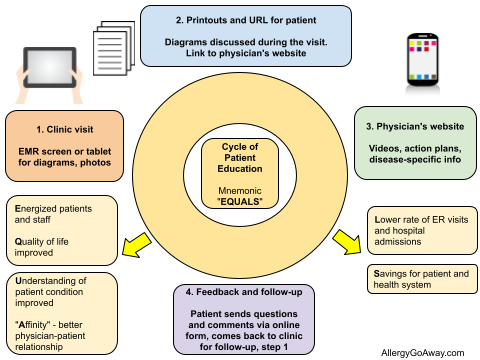
Cycle of Patient Education (click here to enlarge the image). An editable copy for your presentation is available at Google Drive:


Cycle of Online Information and Physician Education (click here to enlarge the image). An editable copy for your presentation is available at Google Drive:
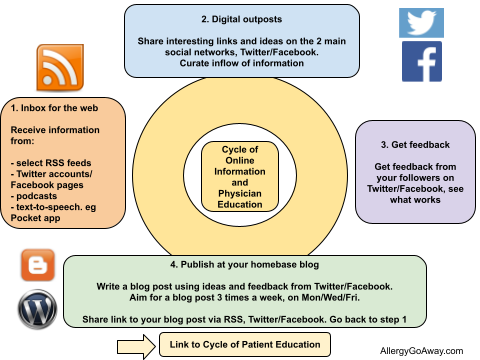


The two cycles work together as two interlocking cogwheels (TIC). Here is how to facilitate the Rise of the ePhysican who works hand in hand with the ePatient:


Products of the Cycle of Patient Education: EQUALS

- Energy!
- Quality of life is improved
- Understanding of patient condition is improved
- "Affinity" - better physician-patient relationship leads to increased referrals to the practice, e.g. 2-5 new patients per week per physician, increased revenue
- Lower rate of ER visits, hospital admissions, phone calls
Savings for patient and health system

References:

Social media: how doctors can contribute. The Lancet, Volume 379, Issue 9826, Page 1562, 28 April 2012.
Social media in medicine: How to be a Twitter rockstar and help your patients and your practice 

Related reading:

Howard Luks MD @hjluks: Many MDs and hospitalis are rushing into a So Me with a lack of proper offline preparation, and the lack of understanding buff.ly/LS5WHt

Comments from Twitter:

@mHIMSS: Nice breakdown! [GRAPHIC] How can #physicians contribute to #patient experience w/ #socialmedia? ow.ly/eQW0L via @DrVes

Laika (Jacqueline) @laikas: Social media: how can doctors contribute? j.mp/PD06fe #socialmedia by @DrVes (with nice Patient Education Cycles) HT @DrShock
1 out of 6 doctors has been rated on a physician-rating website: are
you one of them?

1 out of 6 doctors has been rated on a physician-rating website: are you one of them?

The current usage of physician-rating websites is still low but is increasing. International data show that 1 out of 6 physicians has been rated, and approximately 90% of all ratings on physician-rating websites were positive.

What Percentage of Physicians Has Been Rated?

Data for US physicians obtained from RateMDs showed that 16% of physicians were assessed by January 2010 (112,000 out of approx. 700,000).

What Is the Average Number of Ratings on Physician-Rating Websites?

Nearly half of the physicians had only a single rating on RateMDs in 2010, and the number of physicians with five or more ratings was 12.5%

Although often a concern, the authors of this meta-analysis could not find any evidence of "doctor-bashing".

How Should Physicians Deal With Physician-Rating Websites?

Physicians should not ignore these websites, but rather, monitor the information available and use it for internal and external purpose.

Physicians should perform “self-audits” on popular physician-rating websites to search for available information. It may be helpful if a staff member monitors these sites on a regular basis.

If nothing else, physician-rating websites often provide incorrect demographic information (eg, incorrect address, links to old practices, opening hours), which should be corrected.

Physicians should use the ratings in order to evaluate their patients’ satisfaction. Patients’ true thoughts on what makes a good doctor, what they value, etc., can be understood.

In the case of negative reviews, it is best not to respond online to try to refute the negative review point by point.

What Recommendations Can Be Made for Improvement of Physician-Rating Websites?

Some authors discuss whether a simple One Feedback Question containing a single question such as “Would you recommend Dr X to a loved one?” may be as useful as the multitude of specific questions.

Alemi et al suggest a 2-question survey: the “Minute Survey”. The first question asks patients to rate their overall experience. The second question asks: “Tell us what worked well and what needs improvement”.

References:

Eight Questions About Physician-Rating Websites - JMIR 2013 http://bit.ly/12ifjXA
Image source: RateMDs.com.

Real doctors, real people: from beekeeper to "tough mudder"

Dr. Jonathan Kirsch, a hospitalist at UNC Health Care, is also a beekeeper. He enjoys both the honey and the benefit of pollinated fruit trees and hand-picked fruit.


A team from the UNC Bone Marrow and Stem Cell Transplant Program headed up by Tippu Khan, PharmD, BCOP and Nicole Frazier, RN, BSN participated in an epic journey which included leaping over fire, trekking through waste-high mud, tossing spears, dodging attacks and most of all braving near freezing temperatures in the driving rain. What is all this about? It's the Spartan Race, an event of pure primitive craziness that promises it's participants an experience they'll never forget.


Related:

real doctors, real people - Oliver Smithies - YouTube http://buff.ly/1l8Vcor
30% of doctors have changed a patient's treatment as a result of an
Internet search

30% of doctors have changed a patient's treatment as a result of an Internet search

From AMedNews:

86% of physicians use Internet to access health information. Why not 100%?

72% of physicians start their health information search with a search engine, 92% of those using Google.

A third of doctors have changed a patient's treatment as a result of an Internet search.

Consistent with other search engine research findings that users tend to click the most prominent links, 92% of physician searchers clicked on the links appearing at the top of the page, 46% clicked those in the middle of the page, and 24% clicked on those on the bottom. Also, 8% clicked on sponsored links.

References:
86% of physicians use Internet to access health information. AMedNews.
Image source: Doctors Using Google by Philipp Lenssen, used with permission.
Atul Gawande: "Doctors are human. We miss stuff" - Checklists can help

Atul Gawande: "Doctors are human. We miss stuff" - Checklists can help


Atul Gawande on NPR:

Doctors are human, and that their profession is like any other.

"We miss stuff. We are inconsistent and unreliable because of the complexity of care," Gawande says. "I got a chance to visit Boeing and see how they make things work, and over and over again they fall back on checklists. The pilot's checklist is a crucial component, not just for how you handle takeoff and landing in normal circumstances, but even how you handle a crisis emergency when you only have a couple of minutes to make a critical decision."

References:
Atul Gawande's 'Checklist' For Surgery Success. NPR.

Related:
Sherpaa's take on health insurance: 24/7 phone/email access to doctors,
no need for clinic visit 70% of the time

Sherpaa's take on health insurance: 24/7 phone/email access to doctors, no need for clinic visit 70% of the time


From CBS News:

Dr. Jay Parkinson is trying to change healthcare business with Sherpaa. The company gives 24/7 phone and email access to a group of doctors in New York City. "You can call or email and 70 percent of the time," Parkinson said. "We will solve that problem over email or on the phone."

For example, if you've suffered a nasty cut, you snap a picture, email it to Sherpaa, and a doctor will respond immediately with instructions. If you need stitches, Sherpaa will schedule a same-day appointment with one of the 100 specialist they work with. That could cut out the expense, and long wait on average more than four hours of a visit to the emergency room. Parkinson said instead of getting charged $4,000, it could be a $1,000 charge.

Sherpaa doesn't replace health insurance, but instead works to weed out inefficiencies, while offering a kind of everyman's concierge service. Companies like Tumblr pay about $1,000 a year per employee.

References:

Doctor's company reimagines health care delivery - CBS News http://goo.gl/DLXUd
Are doctors ready for virtual visits? Telemedicine may not be accurate
enough

Are doctors ready for virtual visits? Telemedicine may not be accurate enough

Are Doctors Ready for Virtual Visits? Many fear telemedicine will jeopardize the doctor-patient bond. NYT http://bit.ly/7c2RA8

Telemedicine has a place for second opinion when initiated by a physician but primary assessment is more problematic. One successful example of telemedicine is Cleveland Clinic's second opinion service for physicians abroad. For reference, please see our blog post from a few years ago: Cleveland Clinic Offers a Second Opinion Online for $565 http://bit.ly/4NQyer

The accuracy of teledermatology was inferior to real-life clinic dermatology for melanoma diagnosis http://bit.ly/8A4oiu.


CNN Video: Doctor will see you now -- on Webcam. Telemedicine takes a new turn. Now you can see the doctor while you shop, as CNN's Elizabeth Cohen reports.

Related:
Melanoma - JAMA Patient Page illustrates the ABCDE of diagnosis, 2011.
Skin cancer in the USA - follow Australia's successful "Slip Slop Slap Seek Slide" campaign - The Lancet, 2011.
Telemedicine boosting dermatology care: improved outcomes, with better diagnosis and disease management. AMA News, 2012.

Should Doctors ‘Prescribe’ a Drink a Day? No.

From the NYTimes:

The evidence regarding wine versus other beverages like grape juice is mixed.

For most people, low-risk drinking is not harmful to health — and may be helpful. However, I would discourage people from drinking in order to improve their health.

Compared with non-drinkers, men who consumed wine, beer, or spirits had a 36% lower risk of all-cause mortality and a 34% lower risk of cardiovascular mortality.

Before you recommend wine for cardiovascular risk reduction, consider this:

- One in five men at risk of drinking problem during their lifetimes

- Women have an 8 to 10 percent chance of becoming dependent on alcohol during their lifetimes

- Men have 15% lifetime risk for alcohol abuse, 10% risk for alcohol dependence. Each cuts your life short by 10-15 years.

- Heavy drinking increases risk of depression by 40%, and 80% of people dependent on alcohol are smokers

Alcohol literally kills: Gary Moore had 380mg/dL in his blood, Winehouse 416mg/dL when she died surrounded by 3 empty vodka bottles. Telegraph UK, 2012

References:

Before you recommend wine for CV risk reduction, consider this: 1 in 5 men at risk of drinking problem
Rethinking Drinking - NIH interactive website
Image source: Wikipedia, public domain.

Comments from Twitter:

OMC ‏ @charlesayanleke: That's a recommendation most peeps can get behind

Tibor Banyai ‏ @tibor75: Do u tell your AF pts to be 100% abstinent? Curious RT @drjohnm: RT @DrVes: Should Doctors ‘Prescribe’ a Drink a Day? No.

John Mandrola, MD ‏ @drjohnm:  No I don't rec abstinence but I don't feel that alcohol adds to health. Mild intake prob neutral. Worry about cancer risk


Some nurses paid more than family doctors - CNN

Some nurses paid more than family doctors - CNN

Primary care doctors were offered an average base salary of $173,000 in 2009 compared to an average base salary of $189,000 offered to certified nurse anesthetists, or CRNAs.

It's the fourth year in a row that CRNAs were recruited at a higher pay than a family doctor.

Comments from Google Buzz:

Jeffrey Benabio, MD - And soon doctor of nursing programs will graduate nurses who call themselves "doctor" in clinic. Physicians have been asleep at the wheel.

http://en.wikipedia.org/wiki/Doctorate_in_Nursing

Francesco Diana - without words

Anne Marie Cunningham - Both of these are very high salaries. As @scanman points out, they are unobtainable for most people working in health in India and countries. Can we tolerate such global inequality?

How should salaries in any part of the world be determined? Are both these groups paid too much?

At the moment there is a great deal of uncertainty on how the role of a doctor differs to the role of a nurse. Professor Alan Maynard suggests that professions are bad for healthcare. http://www.healthpolicyinsight.com/?q=node/458 What do you think?

Image source: OpenClipArt.org, public domain.

Benefits and Dangers as Doctors Start to Use Social Media

From Medscape:

"Dr. Choi has more than 3000 Facebook friends, many of whom are patients and colleagues.

But he draws the line at talking about cases with colleagues or sending diagnoses or test results to patients on networking sites. "I can't do any patient care using their messaging or using the site because it's not HIPAA-compliant," Dr. Choi says. "I'll pick up the phone to discuss a case."

Because doctors can be hesitant to share their e-mail addresses -- and regular e-mail is not secure to HIPAA standards -- it's not unheard of for people to find their doctors on Facebook. But the doctors interviewed generally say they avoid making diagnoses or communicating test results over the Internet."

References:
Doctors and Social Media: Benefits and Dangers. Medscape, 2010.
http://www.medscape.com/viewarticle/711717

High-risk profession: Suicide rate of U.S. doctors is one per day

More than a quarter of primary care doctors reported being "burnt out," in part due to worsening time pressures and a chaotic work pace, which were "strongly associated with low physician satisfaction."

The United States loses the equivalent of at least one entire medical school class (approximately 400 physicians) each year to suicide.

In other words, 300-400 doctors in the United States kill themselves every year, or roughly 1 per day. Male doctors have suicide rates 1.4 times that of the general population, while female doctors have twice the rate of depression and 2.3 times the suicide rate when compared with women who are not physicians.

References:

Help for Today's Tense, Frustrated Doctors. Medscape, 2009.
http://www.medscape.com/viewarticle/710904
Doctors have higher rates of suicide than the general population: 40% higher for male doctors, 130% for female doctors http://goo.gl/ckTm
Doctors are quietly opting out of medicine http://goo.gl/emmTA
Image source: Vincent van Gogh's 1890 painting At Eternity's Gate. Wikipedia, public domain.
Doctors use Facebook Pages to connect with patients

Doctors use Facebook Pages to connect with patients

With a 500-million large audience, many practices find that creating a Facebook presence can be an easy -- and free -- way to stay in touch with patients or attract new ones.

Businesses, including physician practices, can create something similar: pages (previously "fan pages"). Anyone on Facebook who elects to "become a fan" or like your page receives, on his or her own home page, any updates, photos, videos or Web links that you post.

Rather than having patients "friend" you on Facebook, you can direct them to this page. Having a moderator is important, because having someone dedicated to responding to people makes them feel more connected and encourages respectful and on topic discussions.

References:
Amednews: How Facebook fan pages can connect with patients.
Facebook Pages Manual.pdf - File Shared from Box.net via @sandnsurf.
10 Easy Ways to Enhance Your Facebook Page. Web Worrker Daily, 2010.
Image source: Wikipedia.

Updated: 07/15/2010
"Doctors should blog with their real name." Agree or disagree?

"Doctors should blog with their real name." Agree or disagree?


From KevinMD:

"Martin Young still has "nagging doubts about doctors who post blogs or replies about healthcare issues without giving their names.

My blog as an extension of who I am as a doctor, putting a carefully considered face to the experience of caring for the sick, as a means of drawing attention to issues that do not get into medical journals. As do most other doctors who host their own blogs.

I often look at those replies to my postings that are anonymous and think, “Who are you? Why do you think the way you do? Why will you not put a name and face to your thoughts?” My personal belief is that the anonymous person may lack conviction, confidence or courage.

I would not accept a referral from an anonymous doctor, or give advice to one. In the same way, I may read anonymous replies to my postings, but they carry much lower weight."

Although I encourage physicians to blog under their own name, I do not think we should "force" them to do so. They should not feel obliged to host their own blog either if they can use such perfectly reasonable free services such as Blogger.com by Google and WordPress.

I assembled a short list of suggestion for medical bloggers several years ago. Here it is:

Tips for Medical Bloggers

- Write as if your boss and your patients are reading your blog every day
- Comply with HIPAA
- Consider using your name and credentials on your blog and other social media accounts
- If your blog is work-related, it is probably better to let your employer know.
- Inquire if there are any employee blogging guidelines. If there are, comply with them strictly.
- Use a disclaimer, e.g. "All opinions expressed here are those of their authors and not of their employer. Information provided here is for medical education only. It is not intended as and does not substitute for medical advice."
- Get your blog accredited by the Heath on the Net Foundation

References:

As A Busy Physician, Why Do I Even Bother Blogging? http://goo.gl/fSF3 - Excellent summary.
Image source: public domain.

Twitter comments:

@DrJenGunter (Jennifer Gunter): depends on blogging agenda.

@DoctorNatasha (Natasha Burgert): I blog and tweet with my real name because it keeps me accountable to my work, honest with my patients, and real with my intent.

@DrElizabethLee: I sign my name to anything I write.

@DrVes: Doctors need to understand the basics, and address the irrational fear of using social media.
Video: Cleveland Clinic Doctors

Video: Cleveland Clinic Doctors


There is a doctor for every patient and there is a patient for every doctor: 2,000 physicians from 80 countries.

Disclaimer: I was a Clinical Assistant Professor of Medicine at the Cleveland Clinic from 2005 to 2008.

DNA Is a Doctor's Best Friend

The Director of the National Institutes of Health (NIH):

"It did affect me to find out that I was at risk for diabetes, which I had no family history of. But my family has all been extremely lean and I was not so lean, as I discovered when I got this information," Collins says.

The "wake-up call" led Collins to switch up his diet and start an exercise program.

His efforts helped him drop 25 pounds.

That impact on behavior is far from universal though. Feedback of DNA based risk assessments does not motivate behaviour change, found a recent BMJ study: http://goo.gl/3HaRy


Human chromosomes (grey) capped by telomeres (white). Image source: Wikipedia, public domain.

References: