
Showing posts with label night. Show all posts

A doctor who loves night shifts

Emergency medicine physician, world-class educator and blogger extraordinaire Dr. Mike Cadogan was recently interviewed by Elsevier Australia:

Interviewer:

What are the best and worst parts of night shifts? Do you have any tips for surviving nights?

Mike Cadogan:

I love night shifts. The dark corridors, the cool air, the rising moon, the autonomy of decision-making, the authority, the midnight snacks and the sense of joyous achievement walking home with the sun rising and against the tide of tired, depressed faces gripping their morning coffees and bemoaning the need to be at work on such a glorious sunny day…

Think positive, be strong and enjoy autonomy. Remember that everybody else is on night shift with you, and most of them don’t want to be there either…but there is no need to be grumpy, rude, or pompous. Make friends with the night owls and collaborate, you will find your workload will dramatically decrease… Make enemies with the permanent night staff at your peril!

References

Interview with Mike Cadogan, author of the acclaimed On Call: Principles and Protocols by Student Ambassador Emma Sharp.
Image source: A halo around the Moon. Wikipedia, GNU Free Documentation License.

Chronic sleep loss decreases performance - One night of good sleep is
not enough to recover from chronic sleep deficit

Chronic sleep loss decreases performance - One night of good sleep is not enough to recover from chronic sleep deficit

On average, a person needs about eight hours a night to preserve performance.

Acute sleep loss is being awake for more than 24 hours in a row and chronic sleep loss is getting only about four to seven hours of sleep per night.

While most people caught up on acute sleep loss with a single night of 10 hours sleep, those with chronic sleep loss showed deteriorating performance for each hour spent awake.

People are largely unaware that they are chronically sleep-deprived but they are more vulnerable to sudden sleepiness, inattentiveness, and potentially, accidents and errors.

Three days is not enough to recover from chronic sleep loss, but they still do not know how many days or weeks may be needed.

References:
Chronic sleep loss hampers performance. Reuters, 2010.
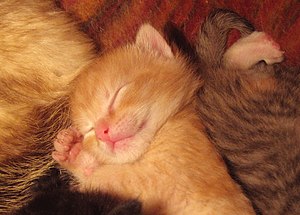
Image source: Sleeping kitten. Wikipedia, Tilman Piesk, public domain.

People who get less than 6 hours sleep per night have an increased risk of dying prematurely

People who get less than 6 hours sleep per night had an increased risk of dying prematurely in a recent study. Those who slept for less than that amount of time were 12% more likely to die early, though researchers also found a link between sleeping more than 9 hours and premature death.

The study aggregated decade-long studies from around the world involving more than 1.3 million people and found "unequivocal evidence of the direct link" between lack of sleep and premature death.

Just one sleepless night can hamper the body's ability to use insulin to process sugar in the bloodstream. Insulin sensitivity is not fixed in healthy people, but depends on the duration of sleep in the preceding night.

"Society pushes us to sleep less and less," one of the study investigators said, adding that about 20% of the population in the United States and Britain sleeps less than 5 hours.

Adults typically need between 7 and 9 hours sleep a night. If you sleep little, you can develop diabetes, obesity, hypertension and high cholesterol.

Image source: A halo around the Moon. Wikipedia, GNU Free Documentation License.
Night shift workers are fighting ancient rhythms that order them to hunt or forage

From the National Geographic Magazine:

We sleep 1.5 hour less a night than we did just 100 years ago

We sleep on average 1.5 hour less a night than we did just a century ago. Some of our epidemic of insomnia or sleeplessness is probably just our refusal to pay attention to our biology. The natural sleep rhythms of teenagers would call for a late morning wake-up—but there they are, starting high school at 8 a.m.

The night shift worker sleeping in the morning is fighting ancient rhythms in his or her body that order him or her awake to hunt or forage when the sky is flooded with light. Yet he or she has no choice.

We fight these forces at our peril. Harvard's researchers note that going without sleep for 24 hours or getting only 5 hours of sleep a night for a week is the equivalent of a blood alcohol level of 0.1 percent. Yet modern business ethic celebrates such feats. "We would never say, 'This person is a great worker! He's drunk all the time!' "

One in 20 medical residents admits to making a fatigue-related mistake that resulted in the death of a patient

A 2004 study included 2,700 first-year medical residents. These young men and women worked shifts that were as long as 30 hours twice a week. The research revealed the remarkable public health risk that this sleep debt entailed. "We know that one out of five first-year residents admits to making a fatigue-related mistake that resulted in injury to a patient. One in 20 admits to making a fatigue-related mistake that resulted in the death of a patient. One day people will look back on what will be viewed as a barbarous practice."

References:
The Secrets of Sleep. National Geographic Magazine, 2011.
Image source: A halo around the Moon. Wikipedia, GNU Free Documentation License.

"Sleep eaters" binge on sugary, high-calorie snacks, sometimes 5 times a night

Consequences of nighttime eating can include injuries like black eyes from walking into a wall or hand cuts from a prep knife, or dental problems from gnawing on frozen food.

Upwards of 10 percent of adults suffer from some sort of parasomnia, or sleep disorder, like sleepwalking or night terrors. Some have driven cars or performed inappropriate sexual acts — all while in a sleep-induced fog. About 1 percent, mostly women, raid the refrigerator.

Image source: A halo around the Moon. Wikipedia, GNU Free Documentation License.