 From American Family Physician:
Depression affects up to 9% of U.S. population.
The U.S. Preventive Services Task Force recommends screening in adolescents and adults but it does not recommend screening for depression in children 7-11 years of age, or screening for suicide risk in the general population.
The Patient Health Questionnaire (PHQ)-2 and PHQ-9 are commonly used and validated screening tools.
The PHQ-2 has a 97% sensitivity and 67% specificity in adults. The PHQ-2 inquires about the frequency of depressed mood and anhedonia over the past 2 weeks, scoring each as 0 ("not at all") to 3 ("nearly every day").
PHQ-9 has a 61% sensitivity and 94% specificity in adults. The PHQ-9 depression module scores each of the 9 DSM-IV criteria as “0” (not at all) to “3” (nearly every day).
If the PHQ-2 is positive for depression, the PHQ-9 should be administered.
In older adults, the 15-item Geriatric Depression Scale is an appropriate follow-up test.
If these screening tests are positive for depression, further evaluation is needed to confirm that the patient's symptoms meet the Diagnostic and Statistical Manual of Mental Disorders' (DSM) criteria for diagnosis.
Suicide is second to only accidental death as the leading cause of mortality in young men across the world. High-lethality methods of suicide are preferred by young men: hanging and firearms in high-income countries, pesticide poisoning in the Indian subcontinent, and charcoal-burning in east Asia (Lancet, 2012).
References:
Screening for depression. Maurer DM. Am Fam Physician. 2012 Jan 15;85(2):139-44.
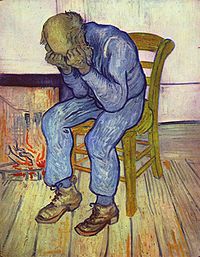
Image source: Vincent van Gogh's 1890 painting At Eternity's Gate. Wikipedia, public domain.