Showing posts with label review. Show all posts
Acute pyelonephritis in women (2011 review)

Acute pyelonephritis in women (2011 review)

This is a 2011 review from the official journal of the AAFP, American Family Physician:

Acute pyelonephritis is a bacterial infection of the renal pelvis and kidney most often seen in young women.

Symptoms of acute pyelonephritis

Most patients have fever, although it may be absent early in the illness. Flank pain is nearly universal.

Tests for acute pyelonephritis

A positive urinalysis confirms the diagnosis.

Urine culture should be obtained in all patients to guide antibiotic therapy if the patient does not respond to initial empiric antibiotic regimens.

Escherichia coli is the most common pathogen in acute pyelonephritis. In the past decade, there has been an increasing rate of E. coli resistance to extended-spectrum beta-lactam antibiotics.

Imaging, usually with contrast-enhanced CT is not necessary unless there is:

- no improvement in the patient's symptoms
- symptom recurrence after initial improvement

Treatment of acute pyelonephritis

Outpatient treatment is appropriate for most patients.

Oral fluoroquinolone is the initial outpatient therapy if the rate of fluoroquinolone resistance in the community is less than 10%. If the resistance rate exceeds 10%, an initial IV dose of ceftriaxone or gentamicin should be given, followed by an oral fluoroquinolone regimen.

Oral beta-lactam antibiotics and trimethoprim/sulfamethoxazole (TMP-SMX (Bactrim) are inappropriate for therapy because of high resistance rates.

References:

Diagnosis and treatment of acute pyelonephritis in women. Colgan R, Williams M, Johnson JR. Am Fam Physician. 2011 Sep 1;84(5):519-26.
Nephrology Cases

Crohn's disease - 2011 review

Crohn's disease is a chronic inflammatory condition affecting the GI tract at any point from the mouth to the rectum.

Symptoms and signs may consist of:

- diarrhea
- abdominal pain
- fever
- weight loss
- abdominal masses
- anemia

Extraintestinal manifestations of Crohn's disease include:

- osteoporosis
- inflammatory arthropathies
- scleritis
- nephrolithiasis
- cholelithiasis
- erythema nodosum

Laboratory findings

Acute phase reactants, such as CRP and ESR, are often increased with inflammation and may correlate with disease activity.

Levels of vitamin B12, folate, albumin, prealbumin, and vitamin D can help assess nutritional status.

Procedures often used to diagnose Crohn's disease:

- colonoscopy with ileoscopy
- capsule endoscopy
- computed tomography (CT) enterography
- small bowel follow-through

Diagnostic tools for extraintestinal manifestations or complications (e.g., abscess, perforation):

- ultrasonography
- computed axial tomography (CT)
- scintigraphy
- MRI

Medical management

Mesalamine products are used for mild to moderate colonic disease. Antibiotics (e.g., metronidazole, fluoroquinolones) are often used for treatment.

Patients with moderate to severe Crohn's disease are treated with:

- corticosteroids
- azathioprine
- 6-mercaptopurine
- anti-tumor necrosis factor agents (e.g., infliximab, adalimumab)

References

Diagnosis and management of Crohn's disease. Wilkins T, Jarvis K, Patel J. Am Fam Physician. 2011 Dec 15;84(12):1365-75.

Image source: Colon (anatomy), Wikipedia, public domain.

Best of Medical Blogs - weekly review, blog carnival

Best of Medical Blogs - weekly review, blog carnival

What happened to "Grand Rounds" medblog carnival?

It's sad to see the demise of "Grand Rounds" medblog carnival. The weekly summary of the best medical blog posts has been published since 2004, with only few breaks. There have not been any editions for more than a month, and no new ones are scheduled. A new initiative by Health Care SoMedia Review could replace some of it http://goo.gl/73RpE

This blog post is a part of a project to recreate a weekly review, or blog carnival, of the best medical blog posts. Feel free to send your suggestions to my email at clinicalcases@gmail.com. The “Best of Medical Blogs - weekly review, blog carnival” will be published on Tuesdays, just like the old Grand Rounds. The last organizers of the Grand Rounds blog carnival. @DrVal and @NickGenes, are aware of this project.

How Doctors Manage Their Social Media Profiles

Personal vs. Professional: How Doctors Manage Their Social Media Profiles is a blog post by Matt Wood of the University of Chicago Medicine blog http://goo.gl/JNyu1. Matt has published a series of great blog posts recently about physicians’ use social media. The doctors at University of Chicago are clearly the leaders in social media use in a city with a rich history of great medical centers such as UChicago Medicine, Northwestern, Childrens’ Memorial, Rush, Loyola and Northshore. Matt tries to find out what makes the UChicago doctors more comfortable using social media that their peers at other institutions: http://goo.gl/JNyu1

Consumers use social media to make medical decisions

Consumer Expectations for Healthcare Social Media - this is a succinct summary by Ed Bennett, “a maker of lists” of healtchare oragnizations that use social media http://goo.gl/REXqV

Digital Strategies for Healthcare Organisations - a good overview by the Australian blog IV line http://goo.gl/PZtWl

Doctors’ salaries

Dr. Mandrola quotes an experienced colleague on doctors' salaries: “We are all happy with what we make. What upsets us most is seeing what others make.” Since then, I try not to dwell on what others make. http://goo.gl/WBnJq

Healthcare social media is a “moral obligation” for doctors

Healthcare social media is a 'moral obligation', says Farris Timimi, M.D., medical director for the Mayo Clinic Center for Social Media, quoted by “Fierce Health IT” . Social media needs to be grown and nurtured for patients. "Our patients are there. Our moral obligation is to meet them where they're at and give them the information they need so they can seek recovery," Dr. Timimi said. "You've got to be ready for it. You build it for the patients; not for yourself. "This is not marketing," he added. "This is the right thing to do." http://goo.gl/BHzKf

Social media is no more a moral obligation for doctors than it is to appear on TV and radio shows, and to write newspaper columns. It is great if you have the time and aptitude to do it, but the most important things is to focus on what matters most - providing correct diagnosis and best possible treatment to your patients.

Comments from Twitter:

Westby Fisher, MD @doctorwes: Best of Medical Blogs - weekly review, RIP blog carnival bit.ly/KsBSLJ

Laika (Jacqueline) @laikas: After the demise of THE Grand Rounds @DrVes starts his own weekly blog review bit.ly/Iqgcmx Gr8 initiative; but still miss the OLD GR

WB Medical Education @WBmeded: Hope to check out some of these later, looks interesting RT @DrVes: Best of Medical Blogs: weekly review, blog carnival goo.gl/fb/d870P

Mike Cadogan @sandnsurf: Another great way to control the information overload with the Best of Medical Blogs - weekly review bit.ly/K1stxo
The Diet Factor in Attention-Deficit/Hyperactivity Disorder -
State-of-the-Art Review Article in Pediatrics

The Diet Factor in Attention-Deficit/Hyperactivity Disorder - State-of-the-Art Review Article in Pediatrics

Diets that were tried in attempt to reduce symptoms associated with attention-deficit/hyperactivity disorder (ADHD) include:

- sugar-restricted
- additive/preservative-free
- oligoantigenic/elimination
- fatty acid supplements

Omega−3 supplement is the latest dietary treatment with positive reports of efficacy. Interest in the additive-free diet of the 1970s is occasionally revived.

Provocative reports have drawn attention to the ADHD-associated “Western-style” diet, high in fat and refined sugars, and the ADHD-free “healthy” diet, containing fiber, folate, and omega-3 fatty acids.

Indications for dietary therapy include:

- medication failure
- parental or patient preference
- iron deficiency
- change from an ADHD-linked Western diet to an ADHD-free healthy diet, when appropriate

In practice, additive-free and oligoantigenic/elimination diets are time-consuming and disruptive to the household; they are indicated only in selected patients.

Iron and zinc are supplemented in patients with known deficiencies; they may also enhance the effectiveness of stimulant therapy.

In patients failing to respond or with parents opposed to medication, omega-3 supplements may warrant a trial.

References:

The Diet Factor in Attention-Deficit/Hyperactivity Disorder. J. Gordon Millichap, MD and Michelle M. Yee, CPNP. PEDIATRICS Vol. 129 No. 2 February 1, 2012, pp. 330 -337, (doi: 10.1542/peds.2011-2199)

Image source: Olive oil, Wikipedia
Best of Medical Blogs - weekly review, blog carnival

Best of Medical Blogs - weekly review, blog carnival

What happened to "Grand Rounds" medblog carnival?

It's sad to see the demise of "Grand Rounds" medblog carnival. The weekly summary of the best medical blog posts has been published since 2004, with only few breaks. There have not been any editions for more than a month, and no new ones are scheduled. A new initiative by Health Care SoMedia Review could replace some of it http://goo.gl/73RpE

This blog post is a part of a project to recreate a weekly review, or blog carnival, of the best medical blog posts. Feel free to send your suggestions to my email at clinicalcases@gmail.com. The “Best of Medical Blogs - weekly review, blog carnival” will be published on Tuesdays, just like the old Grand Rounds. The last organizers of the Grand Rounds blog carnival. @DrVal and @NickGenes, are aware of this project.

How Doctors Manage Their Social Media Profiles

Personal vs. Professional: How Doctors Manage Their Social Media Profiles is a blog post by Matt Wood of the University of Chicago Medicine blog http://goo.gl/JNyu1. Matt has published a series of great blog posts recently about physicians’ use social media. The doctors at University of Chicago are clearly the leaders in social media use in a city with a rich history of great medical centers such as UChicago Medicine, Northwestern, Childrens’ Memorial, Rush, Loyola and Northshore. Matt tries to find out what makes the UChicago doctors more comfortable using social media that their peers at other institutions: http://goo.gl/JNyu1

Consumers use social media to make medical decisions

Consumer Expectations for Healthcare Social Media - this is a succinct summary by Ed Bennett, “a maker of lists” of healtchare oragnizations that use social media http://goo.gl/REXqV

Digital Strategies for Healthcare Organisations - a good overview by the Australian blog IV line http://goo.gl/PZtWl

Doctors’ salaries

Dr. Mandrola quotes an experienced colleague on doctors' salaries: “We are all happy with what we make. What upsets us most is seeing what others make.” Since then, I try not to dwell on what others make. http://goo.gl/WBnJq

Healthcare social media is a “moral obligation” for doctors

Healthcare social media is a 'moral obligation', says Farris Timimi, M.D., medical director for the Mayo Clinic Center for Social Media, quoted by “Fierce Health IT” . Social media needs to be grown and nurtured for patients. "Our patients are there. Our moral obligation is to meet them where they're at and give them the information they need so they can seek recovery," Dr. Timimi said. "You've got to be ready for it. You build it for the patients; not for yourself. "This is not marketing," he added. "This is the right thing to do." http://goo.gl/BHzKf

Social media is no more a moral obligation for doctors than it is to appear on TV and radio shows, and to write newspaper columns. It is great if you have the time and aptitude to do it, but the most important things is to focus on what matters most - providing correct diagnosis and best possible treatment to your patients.

Comments from Twitter:

Westby Fisher, MD @doctorwes: Best of Medical Blogs - weekly review, RIP blog carnival bit.ly/KsBSLJ

Laika (Jacqueline) @laikas: After the demise of THE Grand Rounds @DrVes starts his own weekly blog review bit.ly/Iqgcmx Gr8 initiative; but still miss the OLD GR

WB Medical Education @WBmeded: Hope to check out some of these later, looks interesting RT @DrVes: Best of Medical Blogs: weekly review, blog carnival goo.gl/fb/d870P

Mike Cadogan @sandnsurf: Another great way to control the information overload with the Best of Medical Blogs - weekly review bit.ly/K1stxo
Best of Medical Blogs - weekly review and blog carnival

Best of Medical Blogs - weekly review and blog carnival

The “Best of Medical Blogs - BMB weekly review and blog carnival” is a weekly summary of the best posts from medical blogs. Feel free to send your suggestions to my email at clinicalcases@gmail.com. Best of Medical Blogs (BMB) is published every Tuesday, just like the old Grand Rounds.

A Medical Educator Joins Social Media: One Year Later

Dr. Djuricich, Program Director in Medicine-Pediatrics at the Indiana University, shares what he has learned in one short year: If physicians and other health care professionals are not becoming involved in social media, they are missing out on a “place” where many of the patients already are. There is a lot of misinformation floating around on the internet. It is a duty of physicians to combat this and provide correct information. Do not let social media take over your life. The important things (family, friends, etc.) are still the important things, so don’t lose the priorities. http://goo.gl/zNfpe

What explains blogging longevity? It's easy: blog for yourself, and share with others

Dr. Centor explains his blogging longevity after 10-years of blogging. I've been blogging for 8 years, and I agreee with him: Why you should write a blog for yourself rather than for a shifting audience http://goo.gl/P8xtz

Here's Dr. Centor again: Explaining longevity is subjective. Mostly, I like blogging. Basically I blog with myself in mind, and am gratified that others find my comments interesting. Blogging is never a chore. One cannot last 10 years doing a chore. http://goo.gl/Jyl2o

Cardiologist Dr. Wes nominates the hardest to read Abstract of the Year at 2012 Heart Rhythm Society

What is the abstract that contributes the smallest amount to our field while demonstrating the worst grammar, the most bureaucratic lingo and, of course, verbosity. The sentence that clinched it? "Conclusions: The harmonization of endpoint definitions, terminology, and clinical trial design paradigms provides consistency across clinical trial studies that can facility (sic) clinician acceptance of results and the evaluation of safety and effectiveness of devices and medicines for atrial fibrillation." http://goo.gl/ZstA0

Harvard Medical School Q&A blog doctor reflects on his readers’ feedback

Dr. Komaroff from the blog Ask Doctor K.: “Since I began this column last September, I’ve received a lot of mail — both emails and “snail mail.” Mostly it’s been health questions. I can’t answer them all, but I try to answer as many as I can. However, I’ve also received complaints. Sometimes they represent an honest difference of perspective. On occasion, they reflect the fact that I’m a man.” http://goo.gl/XK3O1

A complete list of all academic medical journals available for the iPad

The omnipresent blog iMedicalApps makes a good use of Google Docs spreadsheet to list the apps of many academic medical journals available for the iPad. I still have personal preference for the open web rather than apps but that’s just me. http://goo.gl/13Gjz

What is postinfectious cough and how to treat it?

From Dr. Matthew Mintz' blog: While the cause of the postinfectious cough is not known, it has been thought to be due to the extensive damage of cells lining the lung and widespread airway inflammation of the upper and/or lower airways. The good news is that this usually goes away by itself, the bad news is that it can take weeks or even months, and can be quite disruptive to patients lives. Since symptoms are caused primarily by inflammation and hyperresponsiveness/bronchoconstriction in the lungs (which is what we see in asthma), then treatment is likely best with something that treats both inflammation and bronchoconstriction in the lungs, such as an inhaled corticosteroid/long-acting beta agonist like Advair (which is commonly used in asthma). Use of Advair for postinfectious cough may be the single most common off-label use of any prescription product. Since inflammation can persist for weeks, it is important that Advair be used for at least 4 weeks. If symptoms return, the patient should be brought back for pulmonary function testing as this may be a new presentation of asthma. http://goo.gl/RgxLb

Reality Social Media: Live Tweeting Brain Surgery. What is the downside of this marketing push? Dr. Wes explains: http://goo.gl/XbKwv

"Healthcare Going To The Dogs" - a video for training hospital administrators http://goo.gl/hv40a and http://goo.gl/xsW4J

Science blogging and self-promotion? http://goo.gl/yGUqS
Best of Medical Blogs - weekly review and blog carnival

Best of Medical Blogs - weekly review and blog carnival

The “Best of Medical Blogs - BMB weekly review and blog carnival” is a weekly summary of the best posts from medical blogs. Feel free to send your suggestions to my email at clinicalcases@gmail.com. Best of Medical Blogs (BMB) is published every Tuesday, just like the old Grand Rounds.

A Medical Educator Joins Social Media: One Year Later

Dr. Djuricich, Program Director in Medicine-Pediatrics at the Indiana University, shares what he has learned in one short year: If physicians and other health care professionals are not becoming involved in social media, they are missing out on a “place” where many of the patients already are. There is a lot of misinformation floating around on the internet. It is a duty of physicians to combat this and provide correct information. Do not let social media take over your life. The important things (family, friends, etc.) are still the important things, so don’t lose the priorities. http://goo.gl/zNfpe

What explains blogging longevity? It's easy: blog for yourself, and share with others

Dr. Centor explains his blogging longevity after 10-years of blogging. I've been blogging for 8 years, and I agreee with him: Why you should write a blog for yourself rather than for a shifting audience http://goo.gl/P8xtz

Here's Dr. Centor again: Explaining longevity is subjective. Mostly, I like blogging. Basically I blog with myself in mind, and am gratified that others find my comments interesting. Blogging is never a chore. One cannot last 10 years doing a chore. http://goo.gl/Jyl2o

Cardiologist Dr. Wes nominates the hardest to read Abstract of the Year at 2012 Heart Rhythm Society

What is the abstract that contributes the smallest amount to our field while demonstrating the worst grammar, the most bureaucratic lingo and, of course, verbosity. The sentence that clinched it? "Conclusions: The harmonization of endpoint definitions, terminology, and clinical trial design paradigms provides consistency across clinical trial studies that can facility (sic) clinician acceptance of results and the evaluation of safety and effectiveness of devices and medicines for atrial fibrillation." http://goo.gl/ZstA0

Harvard Medical School Q&A blog doctor reflects on his readers’ feedback

Dr. Komaroff from the blog Ask Doctor K.: “Since I began this column last September, I’ve received a lot of mail — both emails and “snail mail.” Mostly it’s been health questions. I can’t answer them all, but I try to answer as many as I can. However, I’ve also received complaints. Sometimes they represent an honest difference of perspective. On occasion, they reflect the fact that I’m a man.” http://goo.gl/XK3O1

A complete list of all academic medical journals available for the iPad

The omnipresent blog iMedicalApps makes a good use of Google Docs spreadsheet to list the apps of many academic medical journals available for the iPad. I still have personal preference for the open web rather than apps but that’s just me. http://goo.gl/13Gjz

What is postinfectious cough and how to treat it?

From Dr. Matthew Mintz' blog: While the cause of the postinfectious cough is not known, it has been thought to be due to the extensive damage of cells lining the lung and widespread airway inflammation of the upper and/or lower airways. The good news is that this usually goes away by itself, the bad news is that it can take weeks or even months, and can be quite disruptive to patients lives. Since symptoms are caused primarily by inflammation and hyperresponsiveness/bronchoconstriction in the lungs (which is what we see in asthma), then treatment is likely best with something that treats both inflammation and bronchoconstriction in the lungs, such as an inhaled corticosteroid/long-acting beta agonist like Advair (which is commonly used in asthma). Use of Advair for postinfectious cough may be the single most common off-label use of any prescription product. Since inflammation can persist for weeks, it is important that Advair be used for at least 4 weeks. If symptoms return, the patient should be brought back for pulmonary function testing as this may be a new presentation of asthma. http://goo.gl/RgxLb

Reality Social Media: Live Tweeting Brain Surgery. What is the downside of this marketing push? Dr. Wes explains: http://goo.gl/XbKwv

"Healthcare Going To The Dogs" - a video for training hospital administrators http://goo.gl/hv40a and http://goo.gl/xsW4J

Science blogging and self-promotion? http://goo.gl/yGUqS
Best of Medical Blogs - weekly review and blog carnival

Best of Medical Blogs - weekly review and blog carnival

The “Best of Medical Blogs - BMB weekly review and blog carnival” is a weekly summary of the best posts from medical blogs. Feel free to send your suggestions to my email at clinicalcases@gmail.com. Best of Medical Blogs (BMB) is published every Tuesday, just like the old Grand Rounds.

A Medical Educator Joins Social Media: One Year Later

Dr. Djuricich, Program Director in Medicine-Pediatrics at the Indiana University, shares what he has learned in one short year: If physicians and other health care professionals are not becoming involved in social media, they are missing out on a “place” where many of the patients already are. There is a lot of misinformation floating around on the internet. It is a duty of physicians to combat this and provide correct information. Do not let social media take over your life. The important things (family, friends, etc.) are still the important things, so don’t lose the priorities. http://goo.gl/zNfpe

What explains blogging longevity? It's easy: blog for yourself, and share with others

Dr. Centor explains his blogging longevity after 10-years of blogging. I've been blogging for 8 years, and I agreee with him: Why you should write a blog for yourself rather than for a shifting audience http://goo.gl/P8xtz

Here's Dr. Centor again: Explaining longevity is subjective. Mostly, I like blogging. Basically I blog with myself in mind, and am gratified that others find my comments interesting. Blogging is never a chore. One cannot last 10 years doing a chore. http://goo.gl/Jyl2o

Cardiologist Dr. Wes nominates the hardest to read Abstract of the Year at 2012 Heart Rhythm Society

What is the abstract that contributes the smallest amount to our field while demonstrating the worst grammar, the most bureaucratic lingo and, of course, verbosity. The sentence that clinched it? "Conclusions: The harmonization of endpoint definitions, terminology, and clinical trial design paradigms provides consistency across clinical trial studies that can facility (sic) clinician acceptance of results and the evaluation of safety and effectiveness of devices and medicines for atrial fibrillation." http://goo.gl/ZstA0

Harvard Medical School Q&A blog doctor reflects on his readers’ feedback

Dr. Komaroff from the blog Ask Doctor K.: “Since I began this column last September, I’ve received a lot of mail — both emails and “snail mail.” Mostly it’s been health questions. I can’t answer them all, but I try to answer as many as I can. However, I’ve also received complaints. Sometimes they represent an honest difference of perspective. On occasion, they reflect the fact that I’m a man.” http://goo.gl/XK3O1

A complete list of all academic medical journals available for the iPad

The omnipresent blog iMedicalApps makes a good use of Google Docs spreadsheet to list the apps of many academic medical journals available for the iPad. I still have personal preference for the open web rather than apps but that’s just me. http://goo.gl/13Gjz

What is postinfectious cough and how to treat it?

From Dr. Matthew Mintz' blog: While the cause of the postinfectious cough is not known, it has been thought to be due to the extensive damage of cells lining the lung and widespread airway inflammation of the upper and/or lower airways. The good news is that this usually goes away by itself, the bad news is that it can take weeks or even months, and can be quite disruptive to patients lives. Since symptoms are caused primarily by inflammation and hyperresponsiveness/bronchoconstriction in the lungs (which is what we see in asthma), then treatment is likely best with something that treats both inflammation and bronchoconstriction in the lungs, such as an inhaled corticosteroid/long-acting beta agonist like Advair (which is commonly used in asthma). Use of Advair for postinfectious cough may be the single most common off-label use of any prescription product. Since inflammation can persist for weeks, it is important that Advair be used for at least 4 weeks. If symptoms return, the patient should be brought back for pulmonary function testing as this may be a new presentation of asthma. http://goo.gl/RgxLb

Reality Social Media: Live Tweeting Brain Surgery. What is the downside of this marketing push? Dr. Wes explains: http://goo.gl/XbKwv

"Healthcare Going To The Dogs" - a video for training hospital administrators http://goo.gl/hv40a and http://goo.gl/xsW4J

Science blogging and self-promotion? http://goo.gl/yGUqS
Best of Medical Blogs - weekly review and blog carnival

Best of Medical Blogs - weekly review and blog carnival

The “Best of Medical Blogs - BMB weekly review and blog carnival” is a weekly summary of the best posts from medical blogs. Feel free to send your suggestions to my email at clinicalcases@gmail.com. Best of Medical Blogs (BMB) is published every Tuesday, just like the old Grand Rounds.

A Medical Educator Joins Social Media: One Year Later

Dr. Djuricich, Program Director in Medicine-Pediatrics at the Indiana University, shares what he has learned in one short year: If physicians and other health care professionals are not becoming involved in social media, they are missing out on a “place” where many of the patients already are. There is a lot of misinformation floating around on the internet. It is a duty of physicians to combat this and provide correct information. Do not let social media take over your life. The important things (family, friends, etc.) are still the important things, so don’t lose the priorities. http://goo.gl/zNfpe

What explains blogging longevity? It's easy: blog for yourself, and share with others

Dr. Centor explains his blogging longevity after 10-years of blogging. I've been blogging for 8 years, and I agreee with him: Why you should write a blog for yourself rather than for a shifting audience http://goo.gl/P8xtz

Here's Dr. Centor again: Explaining longevity is subjective. Mostly, I like blogging. Basically I blog with myself in mind, and am gratified that others find my comments interesting. Blogging is never a chore. One cannot last 10 years doing a chore. http://goo.gl/Jyl2o

Cardiologist Dr. Wes nominates the hardest to read Abstract of the Year at 2012 Heart Rhythm Society

What is the abstract that contributes the smallest amount to our field while demonstrating the worst grammar, the most bureaucratic lingo and, of course, verbosity. The sentence that clinched it? "Conclusions: The harmonization of endpoint definitions, terminology, and clinical trial design paradigms provides consistency across clinical trial studies that can facility (sic) clinician acceptance of results and the evaluation of safety and effectiveness of devices and medicines for atrial fibrillation." http://goo.gl/ZstA0

Harvard Medical School Q&A blog doctor reflects on his readers’ feedback

Dr. Komaroff from the blog Ask Doctor K.: “Since I began this column last September, I’ve received a lot of mail — both emails and “snail mail.” Mostly it’s been health questions. I can’t answer them all, but I try to answer as many as I can. However, I’ve also received complaints. Sometimes they represent an honest difference of perspective. On occasion, they reflect the fact that I’m a man.” http://goo.gl/XK3O1

A complete list of all academic medical journals available for the iPad

The omnipresent blog iMedicalApps makes a good use of Google Docs spreadsheet to list the apps of many academic medical journals available for the iPad. I still have personal preference for the open web rather than apps but that’s just me. http://goo.gl/13Gjz

What is postinfectious cough and how to treat it?

From Dr. Matthew Mintz' blog: While the cause of the postinfectious cough is not known, it has been thought to be due to the extensive damage of cells lining the lung and widespread airway inflammation of the upper and/or lower airways. The good news is that this usually goes away by itself, the bad news is that it can take weeks or even months, and can be quite disruptive to patients lives. Since symptoms are caused primarily by inflammation and hyperresponsiveness/bronchoconstriction in the lungs (which is what we see in asthma), then treatment is likely best with something that treats both inflammation and bronchoconstriction in the lungs, such as an inhaled corticosteroid/long-acting beta agonist like Advair (which is commonly used in asthma). Use of Advair for postinfectious cough may be the single most common off-label use of any prescription product. Since inflammation can persist for weeks, it is important that Advair be used for at least 4 weeks. If symptoms return, the patient should be brought back for pulmonary function testing as this may be a new presentation of asthma. http://goo.gl/RgxLb

Reality Social Media: Live Tweeting Brain Surgery. What is the downside of this marketing push? Dr. Wes explains: http://goo.gl/XbKwv

"Healthcare Going To The Dogs" - a video for training hospital administrators http://goo.gl/hv40a and http://goo.gl/xsW4J

Science blogging and self-promotion? http://goo.gl/yGUqS
Best of Medical Blogs - weekly review and blog carnival

Best of Medical Blogs - weekly review and blog carnival

The “Best of Medical Blogs - BMB weekly review and blog carnival” is a weekly summary of the best posts from medical blogs. Feel free to send your suggestions to my email at clinicalcases@gmail.com. Best of Medical Blogs (BMB) is published every Tuesday, just like the old Grand Rounds.

A Medical Educator Joins Social Media: One Year Later

Dr. Djuricich, Program Director in Medicine-Pediatrics at the Indiana University, shares what he has learned in one short year: If physicians and other health care professionals are not becoming involved in social media, they are missing out on a “place” where many of the patients already are. There is a lot of misinformation floating around on the internet. It is a duty of physicians to combat this and provide correct information. Do not let social media take over your life. The important things (family, friends, etc.) are still the important things, so don’t lose the priorities. http://goo.gl/zNfpe

What explains blogging longevity? It's easy: blog for yourself, and share with others

Dr. Centor explains his blogging longevity after 10-years of blogging. I've been blogging for 8 years, and I agreee with him: Why you should write a blog for yourself rather than for a shifting audience http://goo.gl/P8xtz

Here's Dr. Centor again: Explaining longevity is subjective. Mostly, I like blogging. Basically I blog with myself in mind, and am gratified that others find my comments interesting. Blogging is never a chore. One cannot last 10 years doing a chore. http://goo.gl/Jyl2o

Cardiologist Dr. Wes nominates the hardest to read Abstract of the Year at 2012 Heart Rhythm Society

What is the abstract that contributes the smallest amount to our field while demonstrating the worst grammar, the most bureaucratic lingo and, of course, verbosity. The sentence that clinched it? "Conclusions: The harmonization of endpoint definitions, terminology, and clinical trial design paradigms provides consistency across clinical trial studies that can facility (sic) clinician acceptance of results and the evaluation of safety and effectiveness of devices and medicines for atrial fibrillation." http://goo.gl/ZstA0

Harvard Medical School Q&A blog doctor reflects on his readers’ feedback

Dr. Komaroff from the blog Ask Doctor K.: “Since I began this column last September, I’ve received a lot of mail — both emails and “snail mail.” Mostly it’s been health questions. I can’t answer them all, but I try to answer as many as I can. However, I’ve also received complaints. Sometimes they represent an honest difference of perspective. On occasion, they reflect the fact that I’m a man.” http://goo.gl/XK3O1

A complete list of all academic medical journals available for the iPad

The omnipresent blog iMedicalApps makes a good use of Google Docs spreadsheet to list the apps of many academic medical journals available for the iPad. I still have personal preference for the open web rather than apps but that’s just me. http://goo.gl/13Gjz

What is postinfectious cough and how to treat it?

From Dr. Matthew Mintz' blog: While the cause of the postinfectious cough is not known, it has been thought to be due to the extensive damage of cells lining the lung and widespread airway inflammation of the upper and/or lower airways. The good news is that this usually goes away by itself, the bad news is that it can take weeks or even months, and can be quite disruptive to patients lives. Since symptoms are caused primarily by inflammation and hyperresponsiveness/bronchoconstriction in the lungs (which is what we see in asthma), then treatment is likely best with something that treats both inflammation and bronchoconstriction in the lungs, such as an inhaled corticosteroid/long-acting beta agonist like Advair (which is commonly used in asthma). Use of Advair for postinfectious cough may be the single most common off-label use of any prescription product. Since inflammation can persist for weeks, it is important that Advair be used for at least 4 weeks. If symptoms return, the patient should be brought back for pulmonary function testing as this may be a new presentation of asthma. http://goo.gl/RgxLb

Reality Social Media: Live Tweeting Brain Surgery. What is the downside of this marketing push? Dr. Wes explains: http://goo.gl/XbKwv

"Healthcare Going To The Dogs" - a video for training hospital administrators http://goo.gl/hv40a and http://goo.gl/xsW4J

Science blogging and self-promotion? http://goo.gl/yGUqS
Best of Medical Blogs - weekly review and blog carnival

Best of Medical Blogs - weekly review and blog carnival

The “Best of Medical Blogs - BMB weekly review and blog carnival” is a weekly summary of the best posts from medical blogs. Feel free to send your suggestions to my email at clinicalcases@gmail.com. Best of Medical Blogs (BMB) is published every Tuesday, just like the old Grand Rounds.

A Medical Educator Joins Social Media: One Year Later

Dr. Djuricich, Program Director in Medicine-Pediatrics at the Indiana University, shares what he has learned in one short year: If physicians and other health care professionals are not becoming involved in social media, they are missing out on a “place” where many of the patients already are. There is a lot of misinformation floating around on the internet. It is a duty of physicians to combat this and provide correct information. Do not let social media take over your life. The important things (family, friends, etc.) are still the important things, so don’t lose the priorities. http://goo.gl/zNfpe

What explains blogging longevity? It's easy: blog for yourself, and share with others

Dr. Centor explains his blogging longevity after 10-years of blogging. I've been blogging for 8 years, and I agreee with him: Why you should write a blog for yourself rather than for a shifting audience http://goo.gl/P8xtz

Here's Dr. Centor again: Explaining longevity is subjective. Mostly, I like blogging. Basically I blog with myself in mind, and am gratified that others find my comments interesting. Blogging is never a chore. One cannot last 10 years doing a chore. http://goo.gl/Jyl2o

Cardiologist Dr. Wes nominates the hardest to read Abstract of the Year at 2012 Heart Rhythm Society

What is the abstract that contributes the smallest amount to our field while demonstrating the worst grammar, the most bureaucratic lingo and, of course, verbosity. The sentence that clinched it? "Conclusions: The harmonization of endpoint definitions, terminology, and clinical trial design paradigms provides consistency across clinical trial studies that can facility (sic) clinician acceptance of results and the evaluation of safety and effectiveness of devices and medicines for atrial fibrillation." http://goo.gl/ZstA0

Harvard Medical School Q&A blog doctor reflects on his readers’ feedback

Dr. Komaroff from the blog Ask Doctor K.: “Since I began this column last September, I’ve received a lot of mail — both emails and “snail mail.” Mostly it’s been health questions. I can’t answer them all, but I try to answer as many as I can. However, I’ve also received complaints. Sometimes they represent an honest difference of perspective. On occasion, they reflect the fact that I’m a man.” http://goo.gl/XK3O1

A complete list of all academic medical journals available for the iPad

The omnipresent blog iMedicalApps makes a good use of Google Docs spreadsheet to list the apps of many academic medical journals available for the iPad. I still have personal preference for the open web rather than apps but that’s just me. http://goo.gl/13Gjz

What is postinfectious cough and how to treat it?

From Dr. Matthew Mintz' blog: While the cause of the postinfectious cough is not known, it has been thought to be due to the extensive damage of cells lining the lung and widespread airway inflammation of the upper and/or lower airways. The good news is that this usually goes away by itself, the bad news is that it can take weeks or even months, and can be quite disruptive to patients lives. Since symptoms are caused primarily by inflammation and hyperresponsiveness/bronchoconstriction in the lungs (which is what we see in asthma), then treatment is likely best with something that treats both inflammation and bronchoconstriction in the lungs, such as an inhaled corticosteroid/long-acting beta agonist like Advair (which is commonly used in asthma). Use of Advair for postinfectious cough may be the single most common off-label use of any prescription product. Since inflammation can persist for weeks, it is important that Advair be used for at least 4 weeks. If symptoms return, the patient should be brought back for pulmonary function testing as this may be a new presentation of asthma. http://goo.gl/RgxLb

Reality Social Media: Live Tweeting Brain Surgery. What is the downside of this marketing push? Dr. Wes explains: http://goo.gl/XbKwv

"Healthcare Going To The Dogs" - a video for training hospital administrators http://goo.gl/hv40a and http://goo.gl/xsW4J

Science blogging and self-promotion? http://goo.gl/yGUqS
Best of Medical Blogs - weekly review and blog carnival

Best of Medical Blogs - weekly review and blog carnival

The “Best of Medical Blogs - BMB weekly review and blog carnival” is a weekly summary of the best posts from medical blogs. Feel free to send your suggestions to my email at clinicalcases@gmail.com. Best of Medical Blogs (BMB) is published every Tuesday, just like the old Grand Rounds.

A Medical Educator Joins Social Media: One Year Later

Dr. Djuricich, Program Director in Medicine-Pediatrics at the Indiana University, shares what he has learned in one short year: If physicians and other health care professionals are not becoming involved in social media, they are missing out on a “place” where many of the patients already are. There is a lot of misinformation floating around on the internet. It is a duty of physicians to combat this and provide correct information. Do not let social media take over your life. The important things (family, friends, etc.) are still the important things, so don’t lose the priorities. http://goo.gl/zNfpe

What explains blogging longevity? It's easy: blog for yourself, and share with others

Dr. Centor explains his blogging longevity after 10-years of blogging. I've been blogging for 8 years, and I agreee with him: Why you should write a blog for yourself rather than for a shifting audience http://goo.gl/P8xtz

Here's Dr. Centor again: Explaining longevity is subjective. Mostly, I like blogging. Basically I blog with myself in mind, and am gratified that others find my comments interesting. Blogging is never a chore. One cannot last 10 years doing a chore. http://goo.gl/Jyl2o

Cardiologist Dr. Wes nominates the hardest to read Abstract of the Year at 2012 Heart Rhythm Society

What is the abstract that contributes the smallest amount to our field while demonstrating the worst grammar, the most bureaucratic lingo and, of course, verbosity. The sentence that clinched it? "Conclusions: The harmonization of endpoint definitions, terminology, and clinical trial design paradigms provides consistency across clinical trial studies that can facility (sic) clinician acceptance of results and the evaluation of safety and effectiveness of devices and medicines for atrial fibrillation." http://goo.gl/ZstA0

Harvard Medical School Q&A blog doctor reflects on his readers’ feedback

Dr. Komaroff from the blog Ask Doctor K.: “Since I began this column last September, I’ve received a lot of mail — both emails and “snail mail.” Mostly it’s been health questions. I can’t answer them all, but I try to answer as many as I can. However, I’ve also received complaints. Sometimes they represent an honest difference of perspective. On occasion, they reflect the fact that I’m a man.” http://goo.gl/XK3O1

A complete list of all academic medical journals available for the iPad

The omnipresent blog iMedicalApps makes a good use of Google Docs spreadsheet to list the apps of many academic medical journals available for the iPad. I still have personal preference for the open web rather than apps but that’s just me. http://goo.gl/13Gjz

What is postinfectious cough and how to treat it?

From Dr. Matthew Mintz' blog: While the cause of the postinfectious cough is not known, it has been thought to be due to the extensive damage of cells lining the lung and widespread airway inflammation of the upper and/or lower airways. The good news is that this usually goes away by itself, the bad news is that it can take weeks or even months, and can be quite disruptive to patients lives. Since symptoms are caused primarily by inflammation and hyperresponsiveness/bronchoconstriction in the lungs (which is what we see in asthma), then treatment is likely best with something that treats both inflammation and bronchoconstriction in the lungs, such as an inhaled corticosteroid/long-acting beta agonist like Advair (which is commonly used in asthma). Use of Advair for postinfectious cough may be the single most common off-label use of any prescription product. Since inflammation can persist for weeks, it is important that Advair be used for at least 4 weeks. If symptoms return, the patient should be brought back for pulmonary function testing as this may be a new presentation of asthma. http://goo.gl/RgxLb

Reality Social Media: Live Tweeting Brain Surgery. What is the downside of this marketing push? Dr. Wes explains: http://goo.gl/XbKwv

"Healthcare Going To The Dogs" - a video for training hospital administrators http://goo.gl/hv40a and http://goo.gl/xsW4J

Science blogging and self-promotion? http://goo.gl/yGUqS
Best of Medical Blogs - weekly review and blog carnival

Best of Medical Blogs - weekly review and blog carnival

The “Best of Medical Blogs - BMB weekly review and blog carnival” is a weekly summary of the best posts from medical blogs. Feel free to send your suggestions to my email at clinicalcases@gmail.com. Best of Medical Blogs (BMB) is published every Tuesday, just like the old Grand Rounds.

A Medical Educator Joins Social Media: One Year Later

Dr. Djuricich, Program Director in Medicine-Pediatrics at the Indiana University, shares what he has learned in one short year: If physicians and other health care professionals are not becoming involved in social media, they are missing out on a “place” where many of the patients already are. There is a lot of misinformation floating around on the internet. It is a duty of physicians to combat this and provide correct information. Do not let social media take over your life. The important things (family, friends, etc.) are still the important things, so don’t lose the priorities. http://goo.gl/zNfpe

What explains blogging longevity? It's easy: blog for yourself, and share with others

Dr. Centor explains his blogging longevity after 10-years of blogging. I've been blogging for 8 years, and I agreee with him: Why you should write a blog for yourself rather than for a shifting audience http://goo.gl/P8xtz

Here's Dr. Centor again: Explaining longevity is subjective. Mostly, I like blogging. Basically I blog with myself in mind, and am gratified that others find my comments interesting. Blogging is never a chore. One cannot last 10 years doing a chore. http://goo.gl/Jyl2o

Cardiologist Dr. Wes nominates the hardest to read Abstract of the Year at 2012 Heart Rhythm Society

What is the abstract that contributes the smallest amount to our field while demonstrating the worst grammar, the most bureaucratic lingo and, of course, verbosity. The sentence that clinched it? "Conclusions: The harmonization of endpoint definitions, terminology, and clinical trial design paradigms provides consistency across clinical trial studies that can facility (sic) clinician acceptance of results and the evaluation of safety and effectiveness of devices and medicines for atrial fibrillation." http://goo.gl/ZstA0

Harvard Medical School Q&A blog doctor reflects on his readers’ feedback

Dr. Komaroff from the blog Ask Doctor K.: “Since I began this column last September, I’ve received a lot of mail — both emails and “snail mail.” Mostly it’s been health questions. I can’t answer them all, but I try to answer as many as I can. However, I’ve also received complaints. Sometimes they represent an honest difference of perspective. On occasion, they reflect the fact that I’m a man.” http://goo.gl/XK3O1

A complete list of all academic medical journals available for the iPad

The omnipresent blog iMedicalApps makes a good use of Google Docs spreadsheet to list the apps of many academic medical journals available for the iPad. I still have personal preference for the open web rather than apps but that’s just me. http://goo.gl/13Gjz

What is postinfectious cough and how to treat it?

From Dr. Matthew Mintz' blog: While the cause of the postinfectious cough is not known, it has been thought to be due to the extensive damage of cells lining the lung and widespread airway inflammation of the upper and/or lower airways. The good news is that this usually goes away by itself, the bad news is that it can take weeks or even months, and can be quite disruptive to patients lives. Since symptoms are caused primarily by inflammation and hyperresponsiveness/bronchoconstriction in the lungs (which is what we see in asthma), then treatment is likely best with something that treats both inflammation and bronchoconstriction in the lungs, such as an inhaled corticosteroid/long-acting beta agonist like Advair (which is commonly used in asthma). Use of Advair for postinfectious cough may be the single most common off-label use of any prescription product. Since inflammation can persist for weeks, it is important that Advair be used for at least 4 weeks. If symptoms return, the patient should be brought back for pulmonary function testing as this may be a new presentation of asthma. http://goo.gl/RgxLb

Reality Social Media: Live Tweeting Brain Surgery. What is the downside of this marketing push? Dr. Wes explains: http://goo.gl/XbKwv

"Healthcare Going To The Dogs" - a video for training hospital administrators http://goo.gl/hv40a and http://goo.gl/xsW4J

Science blogging and self-promotion? http://goo.gl/yGUqS

Hirsutism in women - literature review

Here some excerpts from the 2012 review of hirsutism in women in the journal American Family Physician:

Hirsutism is excess terminal hair that commonly appears in a male pattern in women.

Although hirsutism is generally associated with hyperandrogenemia, 50% of women with mild symptoms have normal androgen levels.

Causes of hirsutism

The most common cause of hirsutism is polycystic ovary syndrome (PCOS), which accounts for 3 out of every 4 cases.

Many medications can also cause hirsutism.

In patients whose hirsutism is not related to medication use, evaluation is focused on testing for endocrinopathies and neoplasms, such:

- polycystic ovary syndrome (PCOS)
- adrenal hyperplasia
- thyroid dysfunction
- Cushing syndrome
- androgen-secreting tumors

Symptoms of hirsutism

Symptoms and findings suggestive of neoplasm include rapid onset of symptoms, signs of virilization, and a palpable abdominal or pelvic mass.

Patients without these findings who have mild symptoms and normal menses can be treated empirically.

For patients with moderate or severe symptoms, an early morning total testosterone level should be obtained, and if elevated, it should be followed by a plasma free testosterone level.

A total testosterone level greater than 200 ng per dL (6.94 nmol per L) should prompt evaluation for an androgen-secreting tumor.

Diagnosis of hirsutism

Laboratory workup may include:

- early morning total testosterone level
- plasma free testosterone level
- thyroid function tests
- prolactin level
- 17-hydroxyprogesterone level
- corticotropin stimulation test

Treatment of hirsutism

Treatment includes hair removal and pharmacologic measures.

Shaving is effective but needs to be repeated often. Evidence for the effectiveness of electrolysis and laser therapy is limited.

Laser treatment does not result in complete, permanent hair reduction, but it is more effective than other methods such as shaving, waxing, and electrolysis. It produces hair reduction for up to 6 months. The effect is enhanced with multiple treatments.

In patients who are not planning a pregnancy, first-line pharmacologic treatment should include oral contraceptives. Topical agents, such as eflornithine, may also be used.

Treatment response should be monitored for at least six months before making adjustments.

References:

Hirsutism in women. Bode D, Seehusen DA, Baird D. Am Fam Physician. 2012 Feb 15;85(4):373-80.

Management of Hirsutism (Excess Hair)

Image source: Skin layers. Wikipedia, public domain.
Best of Medical Blogs - weekly review and blog carnival

Best of Medical Blogs - weekly review and blog carnival

The “Best of Medical Blogs - BMB weekly review and blog carnival” is a weekly summary of the best posts from medical blogs. Feel free to send your suggestions to my email at clinicalcases@gmail.com. Best of Medical Blogs (BMB) is published every Tuesday, just like the old Grand Rounds.

A Medical Educator Joins Social Media: One Year Later

Dr. Djuricich, Program Director in Medicine-Pediatrics at the Indiana University, shares what he has learned in one short year: If physicians and other health care professionals are not becoming involved in social media, they are missing out on a “place” where many of the patients already are. There is a lot of misinformation floating around on the internet. It is a duty of physicians to combat this and provide correct information. Do not let social media take over your life. The important things (family, friends, etc.) are still the important things, so don’t lose the priorities. http://goo.gl/zNfpe

What explains blogging longevity? It's easy: blog for yourself, and share with others

Dr. Centor explains his blogging longevity after 10-years of blogging. I've been blogging for 8 years, and I agreee with him: Why you should write a blog for yourself rather than for a shifting audience http://goo.gl/P8xtz

Here's Dr. Centor again: Explaining longevity is subjective. Mostly, I like blogging. Basically I blog with myself in mind, and am gratified that others find my comments interesting. Blogging is never a chore. One cannot last 10 years doing a chore. http://goo.gl/Jyl2o

Cardiologist Dr. Wes nominates the hardest to read Abstract of the Year at 2012 Heart Rhythm Society

What is the abstract that contributes the smallest amount to our field while demonstrating the worst grammar, the most bureaucratic lingo and, of course, verbosity. The sentence that clinched it? "Conclusions: The harmonization of endpoint definitions, terminology, and clinical trial design paradigms provides consistency across clinical trial studies that can facility (sic) clinician acceptance of results and the evaluation of safety and effectiveness of devices and medicines for atrial fibrillation." http://goo.gl/ZstA0

Harvard Medical School Q&A blog doctor reflects on his readers’ feedback

Dr. Komaroff from the blog Ask Doctor K.: “Since I began this column last September, I’ve received a lot of mail — both emails and “snail mail.” Mostly it’s been health questions. I can’t answer them all, but I try to answer as many as I can. However, I’ve also received complaints. Sometimes they represent an honest difference of perspective. On occasion, they reflect the fact that I’m a man.” http://goo.gl/XK3O1

A complete list of all academic medical journals available for the iPad

The omnipresent blog iMedicalApps makes a good use of Google Docs spreadsheet to list the apps of many academic medical journals available for the iPad. I still have personal preference for the open web rather than apps but that’s just me. http://goo.gl/13Gjz

What is postinfectious cough and how to treat it?

From Dr. Matthew Mintz' blog: While the cause of the postinfectious cough is not known, it has been thought to be due to the extensive damage of cells lining the lung and widespread airway inflammation of the upper and/or lower airways. The good news is that this usually goes away by itself, the bad news is that it can take weeks or even months, and can be quite disruptive to patients lives. Since symptoms are caused primarily by inflammation and hyperresponsiveness/bronchoconstriction in the lungs (which is what we see in asthma), then treatment is likely best with something that treats both inflammation and bronchoconstriction in the lungs, such as an inhaled corticosteroid/long-acting beta agonist like Advair (which is commonly used in asthma). Use of Advair for postinfectious cough may be the single most common off-label use of any prescription product. Since inflammation can persist for weeks, it is important that Advair be used for at least 4 weeks. If symptoms return, the patient should be brought back for pulmonary function testing as this may be a new presentation of asthma. http://goo.gl/RgxLb

Reality Social Media: Live Tweeting Brain Surgery. What is the downside of this marketing push? Dr. Wes explains: http://goo.gl/XbKwv

"Healthcare Going To The Dogs" - a video for training hospital administrators http://goo.gl/hv40a and http://goo.gl/xsW4J

Science blogging and self-promotion? http://goo.gl/yGUqS
Best of Medical Blogs - weekly review and blog carnival

Best of Medical Blogs - weekly review and blog carnival

The “Best of Medical Blogs - weekly review and blog carnival” is a weekly summary of the best posts from medical blogs. Feel free to send your suggestions to my email at clinicalcases@gmail.com. Best of Medical Blogs (BMB) is published every Tuesday, just like the old Grand Rounds.

The Most Hopeful Job in the World

From Craig Canapari, MD: His "academic achievement would be impressive in anyone. But when you realize that he could not even pick up a pencil, this is really stunning." http://bit.ly/NkPOik

Setting an Example: Eating Well

The “classic” fare of residency (donuts or muffins for breakfast, pizza for lunch, and some fast food on the way home) doesn’t really give you much credibility when you are talking to patients. http://goo.gl/fQlAs

10 Ways to Make EMR Meaningful and Useful 

From Dr. Rob Lamberts http://goo.gl/KimDJ:

- Require all visits to have a simple summary.
- Allow coding gibberish to be hidden.
- Require all ancillary reports to be available to the patient.
- Require integration with a comprehensive and unified patient calendar.
- Put most of the chart in the hands of the patient.
- Pay for e-visits and make them simple for all involved.
- Allow e-prescription of all controlled drugs.
- Require patients’ records to be easily searchable.
- Standardize database nomenclature and decentralize it.
- Outlaw faxing.

Bedside manner in the days of EHR

The $47 billion Kaiser Permanente managed healthcare company has even gone so far as to develop a training methodology for EHR etiquette. It's designed to teach practitioners how to both use electronic tools and be aware there's a patient in the room. http://goo.gl/2LFuk

Called LEVEL, it has five steps:

L -- Let the patient look on
E -- Eye contact
V -- Value the computer
E -- Explain what you’re doing
L -- Log off

Electronic health records changing the character of the family doctor http://goo.gl/iw36b

Are Olympic athletes superhuman? BMJ readers comment: http://goo.gl/bYIRt

The Colonoscopy Experience of a Healthcare CIO http://goo.gl/n2K4D

Fauquier ENT Blog: How Can Nasal Obstruction CAUSE Clogged Ears? http://bit.ly/QGN0ft

Hospitals, Social Media and Compliance - an excellent presentation by Ed Bennett from the blog Found In Cache http://goo.gl/g3qys

Best of Medical Blogs - weekly review and blog carnival

Best of Medical Blogs - weekly review and blog carnival

The “Best of Medical Blogs - weekly review and blog carnival” is a weekly summary of the best posts from medical blogs. Feel free to send your suggestions to my email at clinicalcases@gmail.com. Best of Medical Blogs (BMB) is published every Tuesday, just like the old Grand Rounds.

The Most Hopeful Job in the World

From Craig Canapari, MD: His "academic achievement would be impressive in anyone. But when you realize that he could not even pick up a pencil, this is really stunning." http://bit.ly/NkPOik

Setting an Example: Eating Well

The “classic” fare of residency (donuts or muffins for breakfast, pizza for lunch, and some fast food on the way home) doesn’t really give you much credibility when you are talking to patients. http://goo.gl/fQlAs

10 Ways to Make EMR Meaningful and Useful 

From Dr. Rob Lamberts http://goo.gl/KimDJ:

- Require all visits to have a simple summary.
- Allow coding gibberish to be hidden.
- Require all ancillary reports to be available to the patient.
- Require integration with a comprehensive and unified patient calendar.
- Put most of the chart in the hands of the patient.
- Pay for e-visits and make them simple for all involved.
- Allow e-prescription of all controlled drugs.
- Require patients’ records to be easily searchable.
- Standardize database nomenclature and decentralize it.
- Outlaw faxing.

Bedside manner in the days of EHR

The $47 billion Kaiser Permanente managed healthcare company has even gone so far as to develop a training methodology for EHR etiquette. It's designed to teach practitioners how to both use electronic tools and be aware there's a patient in the room. http://goo.gl/2LFuk

Called LEVEL, it has five steps:

L -- Let the patient look on
E -- Eye contact
V -- Value the computer
E -- Explain what you’re doing
L -- Log off

Electronic health records changing the character of the family doctor http://goo.gl/iw36b

Are Olympic athletes superhuman? BMJ readers comment: http://goo.gl/bYIRt

The Colonoscopy Experience of a Healthcare CIO http://goo.gl/n2K4D

Fauquier ENT Blog: How Can Nasal Obstruction CAUSE Clogged Ears? http://bit.ly/QGN0ft

Hospitals, Social Media and Compliance - an excellent presentation by Ed Bennett from the blog Found In Cache http://goo.gl/g3qys

Managing perioperative risk in patients undergoing elective non-cardiac
surgery - BMJ review

Managing perioperative risk in patients undergoing elective non-cardiac surgery - BMJ review

Non-cardiac surgery has a low overall mortality but is associated with a large number of deaths because so many procedures are performed (250 million major surgical procedures worldwide per year).

Assuming a hospital mortality rate of 1%, non-cardiac surgery will be associated with 2.5 million deaths worldwide each year and complication rates at least five times this figure.

15% of people who undergo inpatient surgery are at high risk of complications, such as pneumonia or myocardial infarction.

Most deaths occur in a group of patients who are at high risk because of:

- advanced age
- comorbid disease
- major surgery

High risk surgical patients account for 80% of all perioperative deaths.

Further research is needed to identify the most effective approaches to perioperative medicine for high risk patients.

References:

Managing perioperative risk in patients undergoing elective non-cardiac surgery. BMJ 2011; 343 doi: 10.1136/bmj.d5759 (Published 5 October 2011), Cite this as: BMJ 2011;343:d5759

Image source: Wikipedia

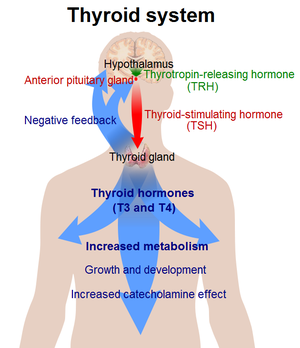
Thyrotoxicosis - Lancet 2012 review

Thyrotoxicosis is a common disorder, especially in women. Thyroid disease affects 7 times more women than men.

Etiology

There are 3 main causes of thyrotoxicosis: Graves' disease, toxic nodular hyperthyroidism, and thyroiditis.

Here are some more details about them:

- Graves' disease (autoimmune hyperthyroidism) is the most frequent cause of thyrotoxicosis
- toxic nodular hyperthyroidism, due to the presence of one or more autonomously functioning thyroid nodules
- thyroiditis caused by inflammation, which results in release of stored hormones

Treatment

The available treatments for thyrotoxicosis have been unchanged for 60 years.

Antithyroid drugs are the usual initial treatment. Thionamides such as carbimazole or its active metabolite methimazole are the drugs of choice.

A prolonged course leads to remission of Graves' hyperthyroidism in only 30% of cases.

Because of this low remission rate in Graves' disease (only 30%) and the inability to cure toxic nodular hyperthyroidism with antithyroid drugs alone, radioiodine is increasingly used as first line therapy. It is the preferred choice for relapsed Graves' hyperthyroidism.

Surgery with total thyroidectomy is an option in selected cases. .

References:

Thyrotoxicosis. The Lancet, Volume 379, Issue 9821, Pages 1155 - 1166, 24 March 2012.

Thyroid disease—more research needed. The Lancet, Volume 379, Issue 9821, Page 1076, 24 March 2012.

Image source: Wikipedia, public domain.

Chronic insomnia - Lancet 2012 review

Insomnia is a common condition that can present independently or comorbidly with another medical or psychiatric disorder.

Treatment of chronic insomnia

Benzodiazepine-receptor agonists (BzRAs) and cognitive-behavioural therapy (CBT) are supported by the best empirical evidence.

Benzodiazepine-receptor agonists (BzRAs) are effective in the short-term management of insomnia, but evidence of long-term efficacy is scarce. Also, most hypnotic drugs are associated with potential adverse effects.

Cognitive-behavioural therapy (CBT) is an effective alternative for chronic insomnia.

CBT is more time consuming than drug management but it produces sleep improvements that are sustained over time.

However, CBT is not readily available in most clinical settings. Access and delivery can be made easier through:

- telephone consultations
- group therapy
- self-help approaches

How to succeed? Get more sleep


In this 4-minute talk, Arianna Huffington (founder of The Huffington Post) shares a small idea that can awaken much bigger ones: the power of a good night's sleep. Instead of bragging about our sleep deficits, she urges us to sleep our way to increased productivity and happiness -- and smarter decision-making.

References:

Chronic insomnia. The Lancet, Volume 379, Issue 9821, Pages 1129 - 1141, 24 March 2012.
Image source: A halo around the Moon. Wikipedia, GNU Free Documentation License.