Showing posts with label guidelines. Show all posts

Diagnosis and Management of COPD - Current Guidelines

WHO estimates that 210 million people have COPD worldwide. COPD is the 4th leading cause of death in the world, but by 2030 it is expected to be the 3rd, behind CAD and stroke (http://bit.ly/X5nje). COPD mortality is inversely correlated to the forced expiratory volume (FEV1) in 1 second (http://bit.ly/ZYIR7).

Here are the key recommendations from the recently published Guidelines for management of stable chronic obstructive pulmonary disease (COPD):

1. Spirometry should be obtained to diagnose airflow obstruction in patients with respiratory symptoms. Spirometry should not be used to screen for airflow obstruction in individuals without respiratory symptoms.

2. For stable COPD patients with respiratory symptoms and FEV1 between 60% and 80% predicted, treatment with inhaled bronchodilators may be used.

3. For stable COPD patients with respiratory symptoms and FEV1 <60% predicted, inhaled bronchodilators should be used.

4. Clinicians should prescribe monotherapy using either long-acting inhaled anticholinergics (LAMA) or long-acting inhaled β-agonists (LABA) for symptomatic patients with COPD and FEV1 <60% predicted.

5. Clinicians may administer combination inhaled therapies (long-acting inhaled anticholinergics, long-acting inhaled β-agonists, or inhaled corticosteroids, LABA/ICS) for symptomatic patients with stable COPD and FEV1<60% predicted.

6. Clinicians should prescribe pulmonary rehabilitation for symptomatic patients with an FEV1 <50% predicted. Clinicians may consider pulmonary rehabilitation for symptomatic or exercise-limited patients with an FEV1 >50% predicted.

7. Clinicians should prescribe continuous oxygen therapy in patients with COPD who have severe resting hypoxemia (PaO2 ≤55 mm Hg or SpO2 ≤88%).

References:

Diagnosis and Management of Stable Chronic Obstructive Pulmonary Disease: A Clinical Practice Guideline Update from the American College of Physicians, American College of Chest Physicians, American Thoracic Society, and European Respiratory Society. ACP, 08/2011. Annals of Int Medicine, 2011.

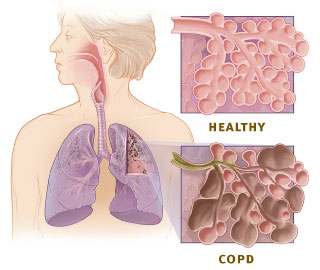
Image source: Enlarged view of lung tissue showing the difference between healthy lung and COPD, Wikipedia, public domain.

Drowning Prevention Guidelines

Here is a video from the Cleveland Clinic:


Key risk factors for drowning are:

- male sex
- age of less than 14 years
- alcohol use
- low income
- poor education
- rural residency
- aquatic exposure
- risky behavior
- lack of supervision

For people with epilepsy, the risk of drowning is 15 to 19 times as high as the risk for those who do not have epilepsy.

For every person who dies from drowning, another four persons receive care in the emergency department for nonfatal drowning.

Drowning Doesn’t Look Like Drowning

- Except in rare circumstances, drowning people are physiologically unable to call out for help. The respiratory system was designed for breathing. Speech is the secondary or overlaid function. Breathing must be fulfilled, before speech occurs.

- Drowning people’s mouths alternately sink below and reappear above the surface of the water.

- The mouths of drowning people are not above the surface of the water long enough for them to exhale, inhale, and call out for help. When the drowning people’s mouths are above the surface, they exhale and inhale quickly as their mouths start to sink below the surface of the water.

- Drowning people cannot wave for help. Nature instinctively forces them to extend their arms laterally and press down on the water’s surface. Pressing down on the surface of the water, permits drowning people to leverage their bodies so they can lift their mouths out of the water to breathe.

- Throughout the Instinctive Drowning Response, drowning people cannot voluntarily control their arm movements. Physiologically, drowning people who are struggling on the surface of the water cannot stop drowning and perform voluntary movements such as waving for help, moving toward a rescuer, or reaching out for a piece of rescue equipment.

- From beginning to end of the Instinctive Drowning Response people’s bodies remain upright in the water, with no evidence of a supporting kick. Unless rescued by a trained lifeguard, these drowning people can only struggle on the surface of the water from 20 to 60 seconds before submersion occurs.

References:

Drowning Doesn’t Look Like Drowning. Mario Vittone.On Scene Magazine: Fall 2006 (page 14)
Drowning - free NEJM review, 2012 http://goo.gl/xSqLu

Guidelines for Management of Acute Bacterial Sinusitis by Infectious Diseases Society of America

A bacterial cause accounts for 2%-10% of acute rhinosinusitis cases.


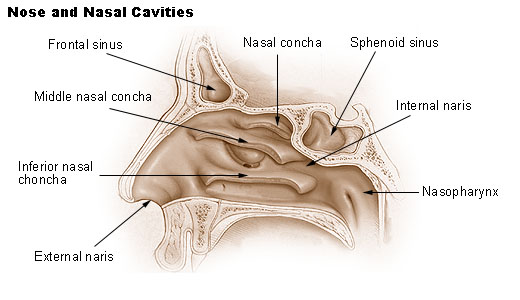
Nose and nasal cavities. Image source: Wikipedia, public domain.

Recommendations for Management of Acute Bacterial Sinusitis by the Infectious Diseases Society of America (IDSA):

Bacterial rather than viral rhinosinusitis should be diagnosed when any of the following occurs:

- persistent symptoms lasting at least 10 days, without improvement
- symptoms or high fever and purulent nasal discharge or facial pain for 3–4 days at illness onset
- worsening symptoms after an initial respiratory infection, lasting 5–6 days, has started to improve.

Empirical therapy should be started as soon as acute bacterial rhinosinusitis is diagnosed clinically.

Amoxicillin-clavulanate, instead of amoxicillin alone, is recommended for both children and adults.

Macrolides and trimethoprim-sulfamethoxazole are not recommended as empirical therapy, because of high rates of antimicrobial resistance.

References:

Algorithm for the management of acute bacterial rhinosinusitis (figure)
Guideline Issued for Managing Acute Bacterial Rhinosinusitis - Physician's First Watch http://bit.ly/TGn6aM
IDSA Clinical Practice Guideline for Acute Bacterial Rhinosinusitis in Children and Adults http://bit.ly/TGnaHB
Guidance on Blogger Disclosure and FTC Guidelines

Guidance on Blogger Disclosure and FTC Guidelines

According to Edelman:

You don’t have to disclose anything if you are just a fan. If you happen to love Toyota and write about them, you don’t need to make a special disclosure that you own a Toyota. However, if Toyota gives you a car to use for two weeks, you must disclose this. It is Toyota’s responsibility to tell you that you need to disclose.

Transparency is key – if you are being paid, you must say that you are being paid. If you are receiving products or services, you must disclose such.

There is no difference in disclosure for product vs. services vs. coupons or discounts. You must disclose all of them.

You must disclose somewhere in the post itself. It is not enough to post a blanket disclosure in the "About Us" section or sidebar of your site. The same applies to tweets. You must disclose in each tweet.There are popular hashtags for disclosure, which include #paid #ad #spon and #sample.

You can also go directly to the source - see the FTC and WOMMA guidance documents on disclosure:


References:
What Should Be In A Blog’s Disclaimer? http://goo.gl/6gGf
Generate a blog disclosure policy here: http://bit.ly/bvEM94
Image source: Blogger.com.

New CPR Guidelines - Hands Only - Use "CAB" Instead of "ABC" While Singing "Stayin' Alive"


The American Heart Association is adopting new cardiopulmonary Resuscitation (CPR) guidelines that do away with mouth to mouth resuscitation and focus on chest compressions. Do fast, forceful compressions; the beat of "Stayin' Alive" is the right pace - 100 beats per minute. Queen's "Another one bites the dust" was rejected as an alternative song choice.

Currently, this recommendation only applies to laymen CPR. The professional rescuers (EMTs, doctors, etc.) should use the previous approach with a compression-breathing (ventilation) ratio of 30:2.

However, “chest compression only” CPR is recommended if the rescuer is not trained (for example, in dispatcher assisted CPR) or is not willing to give rescue breaths. The aim is now to compress the chest to a depth of 5-6 cm (rather than 4-5 cm). This recommendation is based on several studies showing that deeper compressions were associated with improved short term outcomes.


Dr. Sanjay Gupta shows Matthew McConaughey the new way of doing CPR on Larry King Live.


Bee Gees - Stayin' Alive.

References:

New CPR is spelled C-A-B. CNN.
New international guidelines on resuscitation. BMJ, 2010.

Related reading:

Dangers of unrecognized heart disease: Husband dies while giving wife CPR (both found dead, age 60, 59) http://goo.gl/LZ39U
British Heart Foundation is urging people to forget "mouth-to-mouth" during CPR: 'no kissing, just hard CPR'. BBC, 2011.

Acute bronchitis: Many patients expect to be treated with antibiotics and cough meds but this differs from guidelines


Mind map of differential diagnosis of cough. See more Allergy and Immunology mind maps here.

Cough is the most common symptom bringing patients to the primary care physician's office. The most common diagnosis in these patients is acute bronchitis, according to a recent review in the official journal of AFP, American Family Physician.

Acute bronchitis should be differentiated from other common causes of cough such as pneumonia and asthma - because the therapies are clearly different.

Symptoms of acute bronchitis typically last 3 weeks. As we already know, the presence of colored (e.g., yellow or green) sputum does not reliably differentiate between bacterial and viral lower respiratory tract infections. This conclusion was contradicted by a recent study: Green or yellow phlegm likely to be bacterial - confirming beliefs by doctors and patients alike (http://goo.gl/zff8X and http://goo.gl/cwKGs).

Viruses cause more than 90% of acute bronchitis, and therefore, antibiotics are generally not indicated. They should be used only if pertussis is suspected to reduce transmission or if the patient is at increased risk of developing pneumonia (e.g., patients 65 years or older).

The typical therapies that have been traditionally used for managing acute bronchitis symptoms have been shown to be ineffective. The U.S. Food and Drug Administration recommends against using cough and cold preparations in children younger than 6 years.

The supplement pelargonium may help reduce symptom severity in adults.

Many patients expect to be treated with antibiotics and cough medications but this differs from evidence-based recommendations.

The CNN video below tries to decipher what hides behind the names of common cough and cold medications:


References:
Diagnosis and treatment of acute bronchitis. Albert RH. Am Fam Physician. 2010 Dec 1;82(11):1345-50.