Showing posts with label years. Show all posts

Symptomatic knee osteoarthritis (OA) increased during the past 20 years but radiographic OA did not

A recent surge in knee replacements is assumed to be due to aging and increased obesity of the U.S. population.

This cross-sectional study used data from 6 NHANES (National Health and Nutrition Examination Survey) surveys between 1971 and 2004 and from 3 examination periods in the FOA (Framingham Osteoarthritis) Study between 1983 through 2005 of the U.S. population.

Prevalence of knee pain increased by 65% in NHANES from 1974 to 1994.

In the FOA Study, prevalence of knee pain and symptomatic knee osteoarthritis doubled in women and tripled in men over 20 years.

However, no such trend was observed in the prevalence of radiographic knee osteoarthritis.

Prevalence of knee pain has increased substantially over 20 years. Obesity accounted for only part of this increase.

Symptomatic knee osteoarthritis increased but radiographic knee osteoarthritis did not. Why the patients are more symptomatic now than 20 years ago?

Research Finds Exercise is Good for Arthritis (a Cleveland Clinic video):


What is Boomeritis?

In 2006, the NYTimes described the health problems of aging baby boomers who continue to exercise: osteoarthritis which needs "knee and hip replacements, surgery for cartilage and ligament damage, and treatment for tendinitis, arthritis, bursitis and stress fractures." Some doctors call this phenomenon "boomeritis" or "Generation Ouch."

References:

Increasing Prevalence of Knee Pain and Symptomatic Knee Osteoarthritis: Survey and Cohort Data. ANN INTERN MED, December 6, 2011, vol. 155 no. 11 725-732.

What is Boomeritis?

Image source: OpenClipart.org, public domain.

Being obese at age 40 reduces life expectancy by 7 years for women and 6 years for men

In Scotland 68.5% of men, 61.8% of women, 36.1% of boys, and 26.9% of girls are classified as overweight or obese.

Being obese at age 40 reduces life expectancy by 7.1 years for women and 5.8 years for men.

The article summarises the most recent recommendations from the Scottish Intercollegiate Guidelines Network (SIGN) on the management of obesity.

References:
Management of obesity: summary of SIGN guideline. Logue et al. 340: c154. BMJ, 2010.

Comments from Google Buzz:

Luke Rosenberger - thanks! looks like original source of the life expectancy data (according to footnote) is actually a 2003 article from annals of internal medicine - http://www.ncbi.nlm.nih.gov/pubmed/12513041

Ves Dimov, M.D. - Looks correct. That's why I always say that we need a medical librarian on board... :)

For Google Buzz and Twitter, I typically link to the source where the text appeared when I first saw it. It's very nice to trace it back to the original source however. Thank you so much.

Luke Rosenberger - makes sense to me. you know us librarians, always reading the footnotes first ;-)

Image source: Wikipedia, public domain.
Lessons from 12 Years of Blogging (from woodtang)

Lessons from 12 Years of Blogging (from woodtang)

Spoken like a true blogger:

"I started this site 12 years ago. That’s longer than my marriage, longer than any job I’ve held, longer than I’ve lived anywhere since I was a kid. Even though I stopped a started blogging here too many times to count, that’s a long time. I feel like that counts for something on the web and I ought to give it some love.

My interest in blogging waned when I started using Twitter, but I’ve always felt something missing when I wanted to write a few paragraphs about something and be done with it."

Read the rest at woodtang.com http://bit.ly/VPuEaP

“Painting is just another way of keeping a diary”, said Pablo Picasso. Blogging is similar in a way but it also helps to collect important ideas, archive news items and create an educational portfolio that is easily shareable with students, colleagues and patients.

In my personal experience, blogging fits nicely in what I call the Cycle of Online Information and Physician Education (click here to enlarge the image).


Comments from Twitter:

Heidi Allen @dreamingspires: Lessons from 12 Years of Blogging (from woodtang) casesblog.blogspot.com/2013/02/lesson… impressive - and makes it sound simple
U.S. May Face Shortage of 150,000 Doctors in 15 Years

U.S. May Face Shortage of 150,000 Doctors in 15 Years

As ranks of insured patients expand, the U.S. may face shortage of 150,000 doctors in 15 years, according to the WSJ. That shortfall is predicted despite a push by teaching hospitals and medical schools to boost the number of U.S. doctors, which now totals about 954,000.

The greatest demand will be for primary-care physicians. These general practitioners, internists, family physicians and pediatricians will have a larger role under the new law, coordinating care for each patient.

Comments from Twitter:

@doctorwes Foreign docs are lining up.

@jmphillips Once I get into medical school, I should be OK!

@ddrullinsky ok Dr. Dimov, I'm on my way to help! thanks for posting my tweet! I hope to be there next year! Great blog BTW!

@a_singledrop but # of US residency spots remains flat. Why's this ok?

@drsteventucker I'm still not moving back!

References:
U.S. Faces Shortage of Doctors - WSJ.com.
Image source: sxc.hu
President Obama has been smoking for 30 years and managed to quit - and
so can you

President Obama has been smoking for 30 years and managed to quit - and so can you


The White House says President Obama has kicked the habit and stopped smoking. "It's been probably about nine months since he last smoked a cigarette," says Robert Gibbs, the President's press secretary, in an interview with CNN. Mr. Obama, like a lot of smokers, has quit before and started back up again. This time may be different. Gibbs says this is the longest he's known the President to go without a cigarette. He quit by chewing Nicorette gum and exercising a lot of will power.

References:

Stop smoking: Follow the President's example. CNN.
The Presidents Club | Photos: Oval Office Secrets from Truman to Obama | TIME, 2012.
Oropharyngeal carcinoma increased by 22% in 6 years, related to rise in
HPV

Oropharyngeal carcinoma increased by 22% in 6 years, related to rise in HPV

Head and neck cancer is the sixth most common cancer. Despite an overall marginal decline in the incidence of most head and neck cancers in recent years, the incidence of oropharyngeal squamous cell carcinoma has increased greatly, especially in the developed world.

In the United States, the incidence of oropharyngeal squamous cell carcinoma increased by 22% between 1999 and 2006.

The increase in incidence of oropharyngeal squamous cell carcinoma seems to be accounted for by a rise in human papillomavirus (HPV) related oropharyngeal carcinoma.

References:

Oropharyngeal carcinoma related to human papillomavirus. BMJ 2010; 340:c1439 doi: 10.1136/bmj.c1439 (Published 25 March 2010).
Image source: HPV types and associated diseases, Wikipedia, public domain.

Twitter comments:

@travispew (Travis Pew): So get your kids the HPV shot.
The 10-year rule: you must persevere with learning and practising for
10 years before making breakthrough

The 10-year rule: you must persevere with learning and practising for 10 years before making breakthrough

From The Lancet:

Hard work is required: “Genius is one per cent inspiration, ninety-nine per cent perspiration” - Thomas Edison

Late in life, Charles Darwin made the same point in a letter to his son: “I have been speculating last night what makes a man a discoverer of undiscovered things, and a most perplexing problem it is.—Many men who are very clever,—much cleverer than the discoverers—never originate anything. As far as I can conjecture, the art consists in habitually searching for causes or meaning of everything which occurs.” Darwin was a relentless student of nature from 1828 until the few weeks in late 1838 when he suddenly perceived the mechanism of evolution by natural selection.

There can be no doubt that geniuses have worked habitually and continually. Darwin produced 160 published papers, in addition to celebrated books and a vast correspondence. Albert Einstein had 240 publications, Sigmund Freud 330, Henri Poincaré 500 papers and 30 books; Edison was the owner of 1093 patents, lodging an average of one patent every 2 weeks of his adult life. In the arts, J S Bach on average composed 20 pages of finished music per day, while Pablo Picasso created more than 20,000 works.

Experience is essential: “Where observation is concerned, chance favours only the prepared mind” - Louis Pasteur

The 10-year rule states that a person must persevere with learning and practising a craft or discipline for about 10 years before he or she can make a breakthrough. The initial scientific evidence for the rule came from studies in the 1960s and 1970s of chess-players, who take 10 years and more to become masters of the game. Then it was found to apply to Olympic swimmers and concert pianists.

Hardly any genius in history—not even Leonardo da Vinci—seems to have short-cut the long and gradual path to creative breakthroughs.

References

Perspiration, inspiration, and the 10-year rule. The Lancet, Volume 376, Issue 9751, Pages 1458 - 1459, 30 October 2010.

Twitter comments:

@equijada: the ability to infer disparate ideas into one is the 1%. The rest is just salty water. 10-yrs, 10,000 hrs -> playing w/ observations
How much heat you can take? 232 years ago, three British gentlemen
found out

How much heat you can take? 232 years ago, three British gentlemen found out

Have you ever wondered how much heat you can take? 232 years ago, three British gentlemen decided to find out: 260 degrees Fahrenheit (126.6 degrees Celsius).

From NPR:


Be sure to check the cartoon slideshow too.

1 in 40 adults older than 40 years has glaucoma

One in 40 adults older than 40 years has glaucoma with loss of visual function.

Adults have one of the two forms of glaucoma:

- open-angle glaucoma
- angle-closure glaucoma

Diagnosis

At least half of glaucoma cases are undiagnosed. Glaucoma is mostly asymptomatic until late in the disease when visual problems arise. Vision loss from glaucoma cannot be recovered.

Treatment

Glaucoma is treated with daily eye-drop drugs, but adherence to treatment is often unsatisfactory.

Similarities to the pathogenesis of common CNS diseases mean that common neuroprotective strategies might exist. Successful gene therapy has been used for some eye diseases and may be possible for the treatment of glaucoma in the future.

References:
Glaucoma. The Lancet, Volume 377, Issue 9774, Pages 1367 - 1377, 16 April 2011.
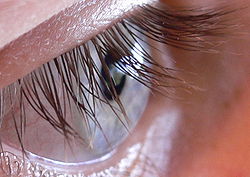
Image source: Eyelashes, Wikipedia, Steve Jurvetson, Creative Commons Attribution 2.0 Generic license.