Showing posts with label diabetes. Show all posts
Diabetes drug injected once a week gets F.D.A. approval: Bydureon
(long-acting exenatide)

Diabetes drug injected once a week gets F.D.A. approval: Bydureon (long-acting exenatide)

From the NYTimes:

The FDA twice declined to approve long-acting exenatide (Bydureon) in 2010, with its most serious concern being that the drug might contribute to heart rhythm abnormalities. There are safety concerns involving thyroid cancer and pancreatitis.

Bydureon is a longer-lasting version of Amylin’s existing drug Byetta, which is injected twice a day. Another company, Alkermes, supplied the technology that slowly releases Bydureon inside the body.

Bydureon, Byetta and Victoza are drugs called GLP-1 receptor agonists, which mimic the effect of glucagonlike peptide- 1, a hormone that increases insulin production when blood sugar is high.
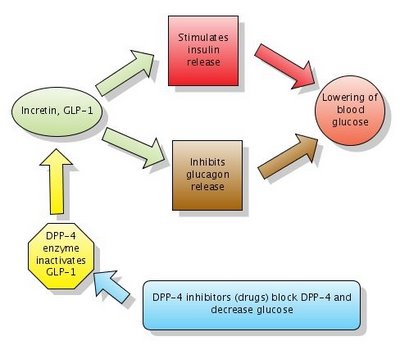

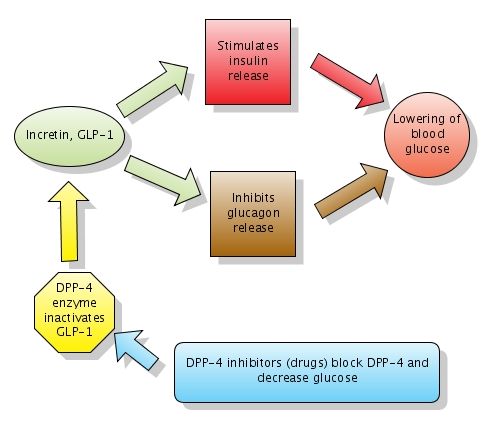
Figure: Action of DPP-4 inhibitors. Note that DPP-4 normally inactivates GLP-1. DPP-4 inhibitors block DPP-4 which in turn leaves GLP-1 active. Click to enlarge the figure. I made the figure with Gliffy in 2006 . The diagram Action of DPP-4 inhibitors is now widely used in many articles on Wikipedia, with my permission.

The main ingredient in both Bydureon and Byetta is exenatide, a hormone derived from the saliva of the Gila monster, a poisonous lizard found in the Southwestern United States and Mexico.

Wholesale price of Bydureon would be $323 for 4 doses, or about $4,200 a year. That is between the roughly $3,400 for the low dose of Victoza and $5,000 for the high dose.

References:

Diabetes Drug Injected Weekly Wins F.D.A. Approval. NYTimes.

Comments from Twitter:

Vaughn Eyvazian @Vaughnsays: Increase that pt compliance!

Reinaldo B. @basanezrx: but nobody stays in the lowest dose of Victoza in my experience, and that's why most ins companies pay for Byetta instead. A shame :(

Risk of diabetes and stroke may be influenced by what we experienced in the womb

The risk of suffering diabetes or a stroke in later years may be influenced by what we experience in the womb. Medical researchers at Jena's University Hospital are investigating the long-term effects of prenatal stress on children now 8-10 years old.


Source: Research on Aging - Stress in the Womb | Tomorrow Today - YouTube http://bit.ly/15DQTtm

The diabetes pandemic: 1 in 4 U.S. adults now has diabetes

The number of adults with diabetes has doubled within the past 30 years.

70% of the increase is attributed to population growth and ageing. However, the number also reflects the unfortunate global shift towards a western lifestyle of unhealthy diet and physical inactivity, with obesity as the outcome.

Between 1980 and 2008, the global body-mass index (BMI) increased by 0·4—0·5 kg/m2 per decade.

In the USA, 10% of infants and toddlers already carry excess weight. More than 20% of children between the ages of 2 years and 5 years are overweight or obese.

By 2030, the number of individuals with diabetes worldwide is expected to rise to half a billion (470 million) - almost 80% of whom will be in low-income and middle-income countries. In these regions, diabetes drugs and insulin are often inaccessible or are too expensive.

References:
The diabetes pandemic. The Lancet, Volume 378, Issue 9786, Page 99, 9 July 2011.
Image source: Wikipedia, public domain.

Related from Amazon - pancreas plush toy:

Neurological and autoimmune disorders after influenza vaccination: no change in risk for Guillain-Barré syndrome, MS, type 1 diabetes, or RA

This Swedish retrospective cohort study, published in BMJ, examined the risk of neurological and autoimmune disorders in people vaccinated against pandemic influenza A (H1N1) with Pandemrix (GlaxoSmithKline) compared with unvaccinated people over 8-10 months.


Image of the H1N1 Influenza Virus, CDC.

One million people were vaccinated against H1N1 and 900,000 remained unvaccinated.

Excess risks among vaccinated people were of low magnitude, but present, for:

- Bell’s palsy (hazard ratio 1.25)
- paresthesia (1.11)
- inflammatory bowel disease (IBD)

Risks for Guillain-Barré syndrome, multiple sclerosis, type 1 diabetes, and rheumatoid arthritis remained unchanged.

The risks of paresthesia and inflammatory bowel disease (IBD) among those vaccinated in the early phase (within 45 days) of the vaccination campaign were significantly increased; the risk being increased within the first 6 weeks after vaccination.

The risks were small but significant among more than one million vaccinated, but only in high risk groups targeted for early vaccination and who were likely to have earlier comorbidity.

The absolute risk of Bell’s palsy was low, 6.4 cases per 100 000 vaccinated population.

References:

Neurological and autoimmune disorders after vaccination against pandemic influenza A (H1N1) with a monovalent adjuvanted vaccine: population based cohort study in Stockholm, Sweden. BMJ 2011; 343:d5956 doi: 10.1136/bmj.d5956 (Published 12 October 2011).
Commonly used diabetes drug metformin smells bad and this may explain
why many patients stop taking it

Commonly used diabetes drug metformin smells bad and this may explain why many patients stop taking it

According to a new study, the diabetes drug metformin smells like fish or dirty socks to some people and this could account for the well-known side effects of the drug, which can make people nauseated.

But the problem could be solved by coating the pills so they do not smell or release the odor into the stomach, where it can be burped up.
Metformin. Image source: Wikipedia, public domain.

References:
http://www.reuters.com/article/idUSTRE61E54H20100215
People on statins are 9% more likely to develop diabetes according to a
meta-analysis

People on statins are 9% more likely to develop diabetes according to a meta-analysis

From Reuters:

This small risk is outweighed by the drugs' heart-protecting properties but it could prompt a rethink among those with low cardiovascular risk factors who are tempted to take statins to prevent future heart disease.

"It will stop us putting statins in the water, as it were, and mean we give them when appropriate for the right reasons."

Lovastatin, a compound isolated from Aspergillus terreus, was the first statin to be marketed for lowering cholesterol. Image source: Wikipedia, public domain.

Statins are among the most successful drugs of all time and have been credited with preventing millions of heart attacks and strokes.

This Lancet meta-analysis included 13 large randomised controlled trials involving more than 91,000 patients.

Treating 255 patients with statins for 4 years would result in only one extra case of diabetes.

Giving statins to the same group would avoid 5.4 deaths or heart attacks over 4 years, and nearly the same number of strokes.

Clinical practice in patients with moderate or high cardiovascular risk or existing cardiovascular disease should not change.

References:
http://www.thelancet.com/journals/lancet/article/PIIS0140-6736(09)61965-6/fulltext

http://www.reuters.com/article/idUSTRE61G00P20100217

Related:
Statins Don't Cause Diabetes. Dr. Mintz' Blog.

Childhood diabetes associated with increasing birth weight - 7% increase in risk for every 1000 g in weight

Childhood onset diabetes is associated with increasing birth weight, equivalent to a 7% increase in risk for every 1000 g in weight.

Caesarean section increases the risk by around 20%.

The risk of childhood onset diabetes increases with maternal age: 5% for each five years of age.

References:
Maternal age and diabetes in childhood. BMJ 2010;340:c623.
Image source: Wikipedia, GNU Free Documentation License.
New Developments in Treatment of Diabetes Type 2

New Developments in Treatment of Diabetes Type 2

From The Lancet theme issue on diabetes:

Diabetes confers a two-fold excess risk for a wide range of vascular diseases - heart disease and stroke. Adjusted HRs with diabetes were: 2·00 for coronary heart disease; 2·27 for ischaemic stroke; 1·56 for haemorrhagic stroke; 1·84 for unclassified stroke; and 1·73 for the aggregate of other vascular deaths. http://goo.gl/ucF0

Increased occurrence of cough and change in pulmonary function in the group receiving inhaled insulin - Lancet http://goo.gl/ve3G

Once weekly exenatide is an important therapeutic option for patients with type 2 diabetes http://goo.gl/UL3e

Dapagliflozin, sodium-glucose cotransporter-2 inhibitor (SGLT2 inhibitor), provides a new therapeutic option for type 2 diabetes http://goo.gl/FqIM
Preventing diabetes, biological passport for athletes and more from the
Lancet

Preventing diabetes, biological passport for athletes and more from the Lancet

Low-dose combination therapy with rosiglitazone and metformin was highly effective in prevention of type 2 diabetes in patients with impaired glucose tolerance, with little effect on the clinically relevant adverse events of these two drugs.

Preventing type 2 diabetes with low-dose combinations: Lifestyle interventions aimed at reducing bodyweight, and use of metformin, thiazolidinediones, acarbose, and orlistat, reduce the risk of diabetes by 25—60% over 3—6 years

The biological passport and doping in athletics: A biological passport monitors an athlete's blood and body chemistry values over time to assess whether there has been a deviation from an established baseline, thus indirectly detecting illegal manipulation.

A long look at obesity: Even with their primitive understanding of nutrition, our neolithic forebears somehow made the “right choices”, thriving on a wholesome diet of nuts, seeds, and fruits with the occasional piece of meat. And what is more, their rare intake of animal protein could only have been obtained through vigorous exercise, which they would, of course, indulge in every day.
Start metformin early when diabetes type II is first diagnosed

Start metformin early when diabetes type II is first diagnosed

Initiating metformin soon after diabetes diagnosis and while A1C is low might preserve β-cell function, prolong the effectiveness of metformin, reduce lifetime glycemic burden, and prevent diabetes complications.

These findings support the current treatment algorithm for hyperglycemia management that recommends metformin initiation when diabetes is first diagnosed.

References:
Secondary Failure of Metformin Monotherapy in Clinical Practice. Diabetes Care March 2010 vol. 33 no. 3 501-506.

Glycated hemoglobin as a diagnostic test for diabetes predicts mortality more accurately than fasting glucose

Fasting glucose is the standard measure used to diagnose diabetes in the United States. Recently, glycated hemoglobin was also recommended for this purpose.

The glycated hemoglobin value at baseline was associated with newly diagnosed diabetes and cardiovascular outcomes.

For glycated hemoglobin, values of less than 5.0%, 5.0-5.5%, 5.5-6.0%, 6.0-6.5%, and 6.5% or greater, the hazard ratios for diagnosed diabetes were 0.52, 1.00, 1.86, 4.48, and 16.47, respectively.

For coronary heart disease, the hazard ratios were 0.96, 1.00, 1.23, 1.78, and 1.95, respectively. The hazard ratios for stroke were similar.

In contrast, glycated hemoglobin and death from any cause were found to have a J-shaped association curve.

The association between the fasting glucose levels and the risk of cardiovascular disease or death from any cause was not significant.

In this community-based population of nondiabetic adults, glycated hemoglobin was associated with a risk of diabetes and more strongly associated with risks of cardiovascular disease and death from any cause as compared with fasting glucose. These data add to the evidence supporting the use of glycated hemoglobin as a diagnostic test for diabetes.

References:
Image source: OpenClipArt.org, public domain.
Diabetic retinopathy is identified in a third of people with diabetes

Diabetic retinopathy is identified in a third of people with diabetes

Diabetic retinopathy is a common microvascular complication of diabetes, and remains the leading cause of preventable blindness in working-aged people. It is identified in a third of people with diabetes and associated with increased risk of life-threatening systemic vascular complications, including stroke, coronary heart disease, and heart failure.

Optimum control of blood glucose, blood pressure, and possibly blood lipids remains the foundation for reduction of risk of retinopathy development and progression.

Timely laser therapy is effective for preservation of sight in proliferative retinopathy and macular oedema, but its ability to reverse visual loss is poor.

Vitrectomy surgery might occasionally be needed for advanced retinopathy.

New therapies, such as intraocular injection of steroids and antivascular endothelial growth-factor agents, are less destructive to the retina than are older therapies, and could be useful in patients who respond poorly to conventional therapy.

Future treatment modalities include inhibition of other angiogenic factors, regenerative therapy, and topical therapy.

References:
Diabetic retinopathy [Seminar]. Ning Cheung, Paul Mitchell, Tien Yin Wong. Lancet, 2010.
Intensifying glucose control and adding fenofibrate to simvastatin each reduced progression of retinopathy in DM2 http://goo.gl/htHIK

Vitamin D receptor activation with paricalcitol decreases albuminuria in type 2 diabetes

Vitamin D is a steroid hormone and a component of a complex endocrine pathway sometimes called 'vitamin D endocrine system' (Medscape, 2012).  Despite treatment with renin—angiotensin—aldosterone system (RAAS) inhibitors, patients with diabetes have increased risk of progressive renal failure that correlates with albuminuria.

281 patients with type 2 diabetes and albuminuria who were receiving angiotensin-converting enzyme inhibitors or angiotensin receptor blockers were enrolled in this study.

Patients were assigned to receive 24 weeks' treatment with:

- placebo
- 1 μg/day paricalcitol
- 2 μg/day paricalcitol

Paricalcitol (trade name Zemplar, Abbott Laboratories) is an analog of calcitriol, the active form of vitamin D.

The primary endpoint was the percentage change in mean urinary albumin-to-creatinine ratio (UACR).

The change in urinary albumin-to-creatinine ratio (UACR) was: −14% in the 1 μg paricalcitol group, and −20% in the 2 μg paricalcitol group.

The addition of 2 μg/day paricalcitol to RAAS inhibition safely lowers albuminuria in patients with diabetic nephropathy, and could be a novel approach to lower renal risk in diabetes.

References:
Selective vitamin D receptor activation with paricalcitol for reduction of albuminuria in patients with type 2 diabetes (VITAL study): a randomised controlled trial. The Lancet, Volume 376, Issue 9752, Pages 1543 - 1551, 6 November 2010.
Image source: Paricalcitol, Wikipedia, public domain.

What drug to add to maximal metformin therapy for diabetes?

Metformin is the recommended initial drug therapy for patients with type 2 diabetes mellitus (DM). However, the optimal second-line drug when metformin monotherapy fails is unclear.

All noninsulin antidiabetic drugs were associated with similar HbA1c reductions but differed in their associations with weight gain and risk of hypoglycemia.

The different classes of drugs were associated with similar HbA1c reductions (range, 0.64%-0.97%) compared with placebo.

Noninsulin antidiabetic drugs and their effect on body weight:

- thiazolidinediones, sulfonylureas, and glinides were associated with weight gain (range, 1.77-2.08 kg)

- glucagon-like peptide-1 analogs, alpha-glucosidase inhibitors, and dipeptidyl peptidase-4 inhibitors were associated with weight loss or no weight change

Sulfonylureas and glinides were associated with higher rates of hypoglycemia than with placebo.

References:
Image source: Metformin. Wikipedia, public domain.
New treatments for type 2 diabetes

New treatments for type 2 diabetes

It is urgent for new treatment for type 2 diabetes strategies.

Some new approaches include:

Long-acting (E.g. once a week), peptide 1 receptor of post prandial improvement of insulin secretion, excessive production of glucagon and promotion of saturation decrease agonists of the glucagon-like

Inhibitor of Dipeptidylpeptidase Dipeptidyl peptidase 4 (DPP-4), which has the effect of strengthening the endogenous Incretin hormones

Inhibitors of the sodium glucose Kotransporter, to increase the renal elimination of glucose

Inhibitors of 11beta,21-dihydroxypregna-1,4,16-triene-3,20-Dione-hydroxysteroid dehydrogenase 1, the effects of glucocorticoids on liver and fat reduction

-Insulina Liberación Glucokinase activators and pancreatic-g - acid protein-bound Grasos acido receptor agonists, antagonists of glucagon receptors and metabolic inhibitors of liver glucose production are also being studied.


Figure 1 action for the DPP-4 inhibitor. Please note that inactive normal DPP-4 of GLP-1. DPP-4 inhibitors block DPP-4, which in turn, GLP-1 active until late. Click on the image for a larger view. Made with ●capacitar. The Charter of action of DPP-4 inhibitors is now in Wikipedia.

References:

Management of type 2 diabetes: new and future advances in treatment. The Lancet, volume 378 9786-, s. 182-197, July 9, 2011.

Google + comments:

Are Emily-Lu-a question many these treatments by minorities, the higher prevalence of diabetes?

VES DIMOV good question. See also: "for the year 2030 the number of people with diabetes around the world should rise up to 500 million ($ 470 billion) - nearly 80% of them are in countries with low income and middle income countries." In these regions insulin and drugs for the treatment of diabetes often not accessible or are too expensive." Nutrition of early intervention can be the answer for type 2 diabetes.

Emily - Lu "early dietary interventions may be the answer to type 2 diabetes." this is correct, but much easier said this fact. I think in general basic education of the patient.

VES DIMOV diet is difficult to apply from the perspective of the patient. Activity was not the expected in the most recent study reported in the July, 2011 edition of "The Lancet" use magazine.