
Showing posts with label technology. Show all posts
Low-income urban youth are high users of technology but still prefer
face-to-face meetings with doctor

Low-income urban youth are high users of technology but still prefer face-to-face meetings with doctor

From This survey included urban youth (aged 14-24 years) to asses the Use of Technology with Health Care Providers.

Eight focus groups including 82 primarily low-income urban African-American adolescents and young adults were completed.

Low-income urban adolescents and young adults (mean age, 18.5 years) reported high access to and use of technology. However, they still preferred face-to-face meetings with a healthcare provider because they felt that the information provided would be better tailored to their individual needs and more credible. Many worried about the confidentiality of conversations conducted using technology.

In conclusion, although low-income urban youth are high users of technology, they still prefer face-to-face meetings with a healthcare provider.

References:

Use of Technology with Health Care Providers: Perspectives from Urban Youth. Sarah Lindstrom Johnson et al. The Journal of Pediatrics, Volume 160, Issue 6 , Pages 997-1002, June 2012.
Are toddlers taking on too much technology?

iPads are (almost) a part of the natural childhood development according to the book author Patti Summers:

"Welcome to the world of the Digitods: the young children born into the era of mobile technology. These kids are learning faster and better than any generation that has come before them. Take a look at toddlers using an iPad. They are pictures of concentration. Have you ever tried getting a Digitod's attention when he is working with an iPad? It is not easy. Often, the child is so fixated on the work that he protests when he has to move on, even to something as interesting as a snack. Good learning is addictive: the more you get, the more you want."

Why are some researchers on the topic sending their own children to "no digital allowed" schools then?

Watch the CNN interview below for Patti Summers' side of the discussion:

Mipomersen - antisense technology to lower LDL cholesterol

Homozygous familial hypercholesterolaemia is a rare genetic disorder in which both LDL-receptor alleles are defective, resulting in very high concentrations of LDL cholesterol in plasma and premature coronary artery disease. This study investigated the use of an antisense inhibitor of apolipoprotein B synthesis, mipomersen, to lower LDL cholesterol.

Patients aged 12 years and older who were already receiving the maximum tolerated dose of a lipid-lowering drug, were randomly assigned to mipomersen 200 mg subcutaneously every week or placebo for 26 weeks.

34 patients were assigned to mipomersen and 17 to placebo. Mean concentrations of LDL cholesterol at baseline were 11·4 mmol/L in the mipomersen group and 10·4 mmol/L in the placebo group. The mean percentage change in LDL cholesterol concentration was significantly greater with mipomersen (−24·7%) than with placebo (−3·3%).

The most common adverse events were injection-site reactions in 76% of patients in mipomersen group vs 24% in placebo group. 12% of patients in the mipomersen group had increases in alanine aminotransferase of three times or more the upper limit of normal.

Inhibition of apolipoprotein B synthesis by mipomersen represents a novel, effective therapy to reduce LDL cholesterol concentrations in patients with homozygous familial hypercholesterolaemia who are already receiving lipid-lowering drugs, including high-dose statins.

References:
Mipomersen, an apolipoprotein B synthesis inhibitor, for lowering of LDL cholesterol concentrations in patients with homozygous familial hypercholesterolaemia: a randomised, double-blind, placebo-controlled trial. The Lancet, Volume 375, Issue 9719, Pages 998 - 1006, 20 March 2010.
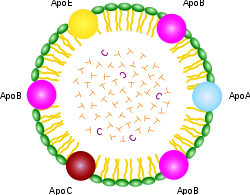
Lipoprotein structure (chylomicron) (left). Image source: Wikipedia, GNU Free Documentation License.

Senior Living - technology for the elderly from Germany (video)

In Germany, as the number of seniors is increasing, the number of younger people is decreasing, and there are not enough caregivers. Scientists are examining a possible role for robots in the care for the elderly.