Showing posts with label literature:. Show all posts

Hirsutism in women - literature review

Here some excerpts from the 2012 review of hirsutism in women in the journal American Family Physician:

Hirsutism is excess terminal hair that commonly appears in a male pattern in women.

Although hirsutism is generally associated with hyperandrogenemia, 50% of women with mild symptoms have normal androgen levels.

Causes of hirsutism

The most common cause of hirsutism is polycystic ovary syndrome (PCOS), which accounts for 3 out of every 4 cases.

Many medications can also cause hirsutism.

In patients whose hirsutism is not related to medication use, evaluation is focused on testing for endocrinopathies and neoplasms, such:

- polycystic ovary syndrome (PCOS)
- adrenal hyperplasia
- thyroid dysfunction
- Cushing syndrome
- androgen-secreting tumors

Symptoms of hirsutism

Symptoms and findings suggestive of neoplasm include rapid onset of symptoms, signs of virilization, and a palpable abdominal or pelvic mass.

Patients without these findings who have mild symptoms and normal menses can be treated empirically.

For patients with moderate or severe symptoms, an early morning total testosterone level should be obtained, and if elevated, it should be followed by a plasma free testosterone level.

A total testosterone level greater than 200 ng per dL (6.94 nmol per L) should prompt evaluation for an androgen-secreting tumor.

Diagnosis of hirsutism

Laboratory workup may include:

- early morning total testosterone level
- plasma free testosterone level
- thyroid function tests
- prolactin level
- 17-hydroxyprogesterone level
- corticotropin stimulation test

Treatment of hirsutism

Treatment includes hair removal and pharmacologic measures.

Shaving is effective but needs to be repeated often. Evidence for the effectiveness of electrolysis and laser therapy is limited.

Laser treatment does not result in complete, permanent hair reduction, but it is more effective than other methods such as shaving, waxing, and electrolysis. It produces hair reduction for up to 6 months. The effect is enhanced with multiple treatments.

In patients who are not planning a pregnancy, first-line pharmacologic treatment should include oral contraceptives. Topical agents, such as eflornithine, may also be used.

Treatment response should be monitored for at least six months before making adjustments.

References:

Hirsutism in women. Bode D, Seehusen DA, Baird D. Am Fam Physician. 2012 Feb 15;85(4):373-80.

Management of Hirsutism (Excess Hair)

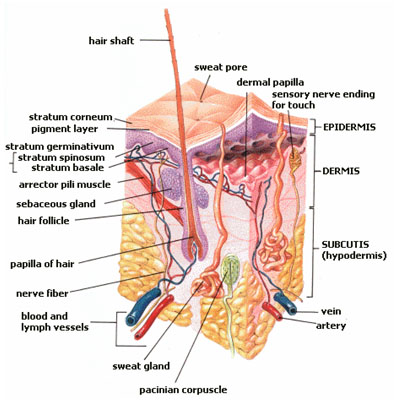
Image source: Skin layers. Wikipedia, public domain.

5 Tips to Stay Up-to-Date with Medical Literature

There is an old saying: "How do you eat in elephant? In small bites." The same rule probably applies to staying current with the ever expanding avalanche of medical literature. You can try the following approach:

1. RSS Feeds for Journals.

Subscribe to the RSS feeds of the "Big Five" medical journals (NEJM, JAMA, BMJ, Lancet and Annals) plus 2-3 subpecialty journals in your field of interest. Any of the many RSS readers would do. I use RSS OwlPeRSSonalized Medicine by Webicina.com was one of the first services to arrange the medical journal feeds in a visually appealing way and make RSS consumption user-friendly. Feedly is one of the most popular online RSS readers.

Try to read the journal on the day it is published online, for example, NEJM and JAMA on Wednesdays, BMJ in Fridays, etc.

2. Podcasts.

Listen to journal podcasts. Many applications are available for desktop and smartphones. All major journals have weekly or monthly podcasts.

3. Persistent Searches.

Subscribe to RSS feeds for "persistent searches" in Pubmed and Google. For example, choose a search term in your field of interest, run the search in Pubmed, then subscribe to the feed for the search. The same process can be repeated with Google News and Google Alerts.


Image source: U.S. National Library of Medicine.

4. Text-to-speech (TTS).

Use text-to-speech to listen to articles you do not have time to read. For example, you can save your articles in the Pocket app for Android and listen to them later.

5. Blogs and Twitter accounts.

Subscribe to high-quality medical blogs and Twitter accounts in your field of interest -- they often review many of the important new articles.

Here is an example of the allergists on Twitter:

This is a list of the allergists who are planning to use Twitter to post updates from the 2013 #AAAAI meeting. The list is open for edit, please feel free to add your own info.


Related reading

How to stay up-to-date with RSS in medicine - presentation from the free Social MEDia Course http://j.mp/Hale12
Not a Medical Course, but a Life Course (somewhat vague advice) http://goo.gl/mDMsr - Here are 5 practical tips:  http://goo.gl/n5rbw
Medical journals that use social media (spreadsheet). Body in Mind, 2011.
Image source: OpenClipArt, public domain.

Note: This is an update of a 2008 article.
"The doctor in literature: Private life" by Solomon Posen at Google
Books

"The doctor in literature: Private life" by Solomon Posen at Google Books

"This is a structured, annotated and indexed anthology dealing with the personality and the behaviour of doctors, and doctor-patient relationships - ideal for medical humanities courses."