Showing posts with label current. Show all posts

Diagnosis and Management of COPD - Current Guidelines

WHO estimates that 210 million people have COPD worldwide. COPD is the 4th leading cause of death in the world, but by 2030 it is expected to be the 3rd, behind CAD and stroke (http://bit.ly/X5nje). COPD mortality is inversely correlated to the forced expiratory volume (FEV1) in 1 second (http://bit.ly/ZYIR7).

Here are the key recommendations from the recently published Guidelines for management of stable chronic obstructive pulmonary disease (COPD):

1. Spirometry should be obtained to diagnose airflow obstruction in patients with respiratory symptoms. Spirometry should not be used to screen for airflow obstruction in individuals without respiratory symptoms.

2. For stable COPD patients with respiratory symptoms and FEV1 between 60% and 80% predicted, treatment with inhaled bronchodilators may be used.

3. For stable COPD patients with respiratory symptoms and FEV1 <60% predicted, inhaled bronchodilators should be used.

4. Clinicians should prescribe monotherapy using either long-acting inhaled anticholinergics (LAMA) or long-acting inhaled β-agonists (LABA) for symptomatic patients with COPD and FEV1 <60% predicted.

5. Clinicians may administer combination inhaled therapies (long-acting inhaled anticholinergics, long-acting inhaled β-agonists, or inhaled corticosteroids, LABA/ICS) for symptomatic patients with stable COPD and FEV1<60% predicted.

6. Clinicians should prescribe pulmonary rehabilitation for symptomatic patients with an FEV1 <50% predicted. Clinicians may consider pulmonary rehabilitation for symptomatic or exercise-limited patients with an FEV1 >50% predicted.

7. Clinicians should prescribe continuous oxygen therapy in patients with COPD who have severe resting hypoxemia (PaO2 ≤55 mm Hg or SpO2 ≤88%).

References:

Diagnosis and Management of Stable Chronic Obstructive Pulmonary Disease: A Clinical Practice Guideline Update from the American College of Physicians, American College of Chest Physicians, American Thoracic Society, and European Respiratory Society. ACP, 08/2011. Annals of Int Medicine, 2011.

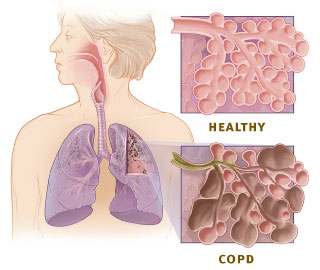
Image source: Enlarged view of lung tissue showing the difference between healthy lung and COPD, Wikipedia, public domain.

The two current heavyweight world boxing champions both have PhDs,
believe or not

The two current heavyweight world boxing champions both have PhDs, believe or not

Believe or not, but the two current heavyweight world boxing champions both have PhDs... The two researchers are the Ukrainian heavyweight boxers and brothers Wladimir and Vitali Klitschko.


Wladimir Klitschko, called "Dr. Steel Hammer"(born 25 March 1976, Semipalatinsk, Kazakhstan), currently holds the IBF, WBO, IBO and Ring Magazine world heavyweight titles. His older brother, Vitali Klitschko, is the current WBC world heavyweight champion.

In the summer of 1996, Klitschko finished Pereyaslav-Khmelnitsky Pedagogical Institute (Ukraine) and was accepted in the postgraduate study program of Kiev University. On 18 January 2001 in a conference hall of Kiev University of physical science and sports, Klitschko presented his doctoral dissertation and was awarded a Ph.D. in Sports Science. Klitschko speaks four languages: Ukrainian, Russian, German and English.

Image source: Wikipedia, GNU Free Documentation License.


Vitali Klitschko, called "Dr. Ironfist", (born 19 July 1971 in Belovodsk, Kirghiz SSR, Soviet Union (now Kyrgyzstan) is a Ukrainian professional heavyweight boxer and the current WBC world heavyweight champion. He has the highest knockout percentage (94.9%) of any heavyweight boxing champion in overall fights.

Vitali is the first professional boxing world champion to hold a Ph.D. In 1996, he graduated from the Pereyaslav-Khmelnytsky Pedagogical Institute (Ukraine) and was accepted into the postgraduate study program at Kiev University. On 29 February 2000, he presented his doctoral thesis on "talent and sponsorship in sports" at the Kiev University of Physical Science and Sports, and his Ph.D. in Sports Science was conferred.

Image source: Wikipedia, GNU Free Documentation License.

What is the current best RSS reader?

After it was announced that Google Reader will be shut down in July, some of my Twitter buddies asked me what I plan to use in the future as a RSS reader.

I have already switched to RSS Owl.

Pros:

- faster and more powerful than Google Reader
- portable program that does not require installation (choose the version labeled "rssowl-2.1.6.windows.zip"). You can take it on a USB drive if you wish.
- keyboard shortcuts - you can either customize the existing shortcuts or create new ones
- social media sharing integration (Buffer, Twitter, Facebook, etc.)
- Easy export and import of your RSS subscriptions as an OPML file
- open source (just like WordPress, Firefox, WebKit, etc.)
- free

Cons:

- it is a downloadable program, not a website

For an online RSS reader, I would recommend Feedly in "Google Reader view". However, I prefer RSS Owl because it is faster and more customizable.

You can make Feedly look like Reader by going to preferences and changing "Default View" to "Condensed".

Why use RSS reader?

RSS is the most efficient way to collect information from multiple websites in one location. If you need to do that, that's the way to do it.

From Rex Hammock:

"I used to attempt to get my friends to use a newsreader. For whatever reason, most never quite got it. It’s one of the few things I use that I consider a competitive advantage and a tool I couldn’t operate professionally without. I decided to stop wasting time trying to give that secret away."

Please share your opinion via Twitter or in the comments section below.

References:

Google Reader was a Google Pigpen product | Rex Hammock's RexBlog.com http://bit.ly/XMB5A0
Which is the Best Alternative to Google Reader http://bit.ly/ZFKLKT

Comments from Twitter:

What is the current best RSS reader? http://bit.ly/WzPXST - I prefer the portable RSS Owl over online Feedly (quicker/custom kb shortcuts)
Current school system is failing boys - how to re-engage them in
learning - TED video

Current school system is failing boys - how to re-engage them in learning - TED video


At TEDxPSU, Ali Carr-Chellman pinpoints 3 reasons boys are tuning out of school in droves, and lays out her bold plan to re-engage them: bringing their culture into the classroom, with new rules that let boys be boys. The first part of the talk points to some eye-opening facts about how the current school system is failing boys.
Google Buzz "antisocial networking" exposed details of “estranged
spouses, current lovers, attorneys and doctors”

Google Buzz "antisocial networking" exposed details of “estranged spouses, current lovers, attorneys and doctors”

From Google: Antisocial networking. FT.com:

At the root of the problem is Google’s decision to use Gmail, with its 175m active users, as a launchpad for its latest push into social networking. All users were enrolled as soon as they clicked a link to look at the service, and many found the names of those they corresponded with most frequently by e-mail – usually a private list – became the basis for a public “social network” of contacts on Buzz. That risked exposing the details of “estranged spouses, current lovers, attorneys and doctors”.


Doctors should be very cautious when using social media to communicate with patients. In general, "friending" patients on Facebook, Buzz and Twitter is not a good idea at the current level of social network services, and is best avoided.

It may be irresponsible to answer patient questions on blogs, Twitter, Buzz and Facebook because no complete data for an informed evaluation and decision can be collected.