
Showing posts with label update:. Show all posts
Showing posts with label update:. Show all posts
Fibromyalgia - An Emerging but Controversial Condition - 2014 JAMA Update
Fibromyalgia is not a rheumatological disease but a central pain syndrome. It is a complicated condition that tends to last a long time, although people do get better.
The syndrome termed fibromyalgia or fibrositis has attracted the interest of investigators for quite some time. Although some authors believe that fibromyalgia is not a discrete condition, rheumatologists now report that fibromyalgia is one of the most common diagnoses in ambulatory practice. Recent estimates of the prevalence of fibromyalgia in the United States have ranged from 3 to 6 million.
This JAMA video introduces a free review article on fibromyalgia from April 2014
What is fibromyalgia?
Fibromyalgia can be thought of as a centralized pain state. Centralized pain is a lifelong disorder beginning in adolescence or young adulthood manifested by pain experienced in different body regions at different times.
How common is fibromyalgia?
Fibromyalgia is present in as much as 2% to 8% of the population, is characterized by widespread pain, and is often accompanied by fatigue, memory problems, and sleep disturbances.
How to treat fibromyalgia?
Numerous treatments are available for managing fibromyalgia that are supported by high-quality evidence:
- nonpharmacological therapies (education, exercise, cognitive behavioral therapy)
- pharmacological therapies (tricyclics, serotonin norepinephrine reuptake inhibitors, and gabapentinoids)
Free content from JAMA:
JAMA | Fibromyalgia: A Clinical Review http://buff.ly/1qH5ITI
JAMA Patient Page | Fibromyalgia http://buff.ly/1qH5HiH
Related reading:
Fibromyalgia is not a rheumatological disease but a central pain syndrome http://buff.ly/1qH4CaH
JAMA Network | JAMA | Fibromyalgia Syndrome: An Emerging but Controversial Condition http://buff.ly/1m6Dv9w
Cirrhosis - 2011 update from Am Fam Physician
 Cirrhosis is the 12th leading cause of death in the United States. The mortality rate is 9.7 per 100,000 persons.
The most common causes of cirrhosis are:
- alcohol abuse
- viral hepatitis
- nonalcoholic fatty liver disease is emerging as an increasingly important cause
Patients with cirrhosis should be screened for hepatocellular carcinoma with imaging studies every 6-12 months.
Causes of hepatic encephalopathy include:
- constipation
- infection
- gastrointestinal bleeding
- some medications
- electrolyte imbalances
- noncompliance with medical therapy
Treatment
Lactulose and rifaximin are aimed at reducing serum ammonia levels.
Ascites should be treated initially with salt restriction and diuresis. Physicians should be vigilant for spontaneous bacterial peritonitis.
Patients with acute GI bleeding should be monitored in an intensive care unit, and should have endoscopy performed within 24 hours.
Prevention
Mechanisms to reduce the incidence of cirrhosis:
- treat alcohol abuse
- screen for viral hepatitis
- control risk factors for nonalcoholic fatty liver disease
Cirrhosis: Phil's story (video):
From NHSChoices: Many people enjoy a drink in the pub after work without realising how social drinking can damage health. Phil didn't realise the harm his alcohol intake was doing until he was diagnosed with cirrhosis of the liver. He talks about his experience and the shock he felt at being diagnosed.
References
Cirrhosis: diagnosis, management, and prevention. Starr SP, Raines D. Am Fam Physician. 2011 Dec 15;84(12):1353-9.
Cirrhosis - JAMA Patient Page, 2012.
The Barefoot Professor says barefoot running could minimize injuries (2014 Update: Not really)
2014 Update: 'Barefoot' Running Heads Into the Sunset - WSJ http://buff.ly/1nuz0E0
NatureVideoChannel — January 27, 2010 — Harvard professor Daniel Lieberman has ditched his trainers and started running barefoot. His research shows that barefoot runners, who tend to land on their fore-foot, generate less impact shock than runners in sports shoes who land heel first. This makes barefoot running comfortable and could minimize running-related injuries. Find the original research here: http://dx.doi.org/10.1038/nature08723
Humans have engaged in endurance running for millions of years1, but the modern running shoe was not invented until the 1970s. For most of human evolutionary history, runners were either barefoot or wore minimal footwear such as sandals or moccasins with smaller heels and little cushioning relative to modern running shoes.
Related reading:
The Barefoot Running Revolution - INFOGRAPHIC http://goo.gl/7SUGs

Evaluation of driving risk in dementia - practice parameter update
For patients with dementia, the following characteristics are useful for identifying
patients at increased risk for unsafe driving:
- Clinical Dementia Rating scale (Level A)
- caregiver’s rating of a patient’s driving ability as marginal or unsafe (Level B)
- history of crashes or traffic citations (Level C)
- reduced driving mileage or self-reported situational avoidance (Level C)
- Mini-Mental State Examination scores of 24 or less (Level C)
- aggressive or impulsive personality characteristics (Level C)

Evaluation of driving risk in dementia (click to enlarge the image).
The following characteristics are not useful for identifying patients at increased risk for unsafe driving:
- patient’s self-rating of safe driving ability (Level A)
- lack of situational avoidance (Level C)
patients at increased risk for unsafe driving:
- Clinical Dementia Rating scale (Level A)
- caregiver’s rating of a patient’s driving ability as marginal or unsafe (Level B)
- history of crashes or traffic citations (Level C)
- reduced driving mileage or self-reported situational avoidance (Level C)
- Mini-Mental State Examination scores of 24 or less (Level C)
- aggressive or impulsive personality characteristics (Level C)
Evaluation of driving risk in dementia (click to enlarge the image).
The following characteristics are not useful for identifying patients at increased risk for unsafe driving:
- patient’s self-rating of safe driving ability (Level A)
- lack of situational avoidance (Level C)
References:
Practice Parameter update: Evaluation and management of driving risk in dementia. Neurology 2010;74:1316–1324 (PDF)
Practice Parameter update: Evaluation and management of driving risk in dementia. Neurology 2010;74:1316–1324 (PDF)
Gout update: New drugs for an old disease
 Febuxostat is a non-purine-analogue inhibitor of xanthine oxidase that opened a new era in the treatment of gout.
Modified uricases
The use of modified uricases to rapidly reduce serum urate concentrations in patients with otherwise untreatable gout is progressing. Pegloticase, a pegylated uricase, is in development.
JAMA update, 08/2011: New Treatment Offers Hope for Patients With Severe Gout: pegloticase (Krystexxa) costs $2,500 per dose (http://goo.gl/gz9sO).
Drugs in development
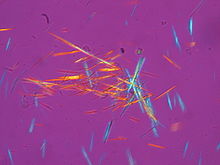
Transport of uric acid in the renal proximal tubule and the inflammatory response to monosodium urate crystals (shown above) are targets for potential new treatments.
Several pipeline drugs for gout related to the targets above include:
- selective uricosuric drug RDEA594
- various interleukin-1 inhibitors. Canakinumab (trade name Ilaris) is a human monoclonal antibody targeted at interleukin-1 beta. It was rejected by the FDA panel in June 2011.
References:
Gout therapeutics: new drugs for an old disease. The Lancet, Volume 377, Issue 9760, Pages 165 - 177, 8 January 2011.
Diuretics, beta-blockers, ACEi, non-losartan ARBs associated with increased risk of gout vs. CCB lower risk. BMJ, 2012.
With FDA Approval, a Gout Drug Now Costs $5 Instead of Pennies - WSJ, 2011.
FDA Panel Rejects Gout Drug Canakinumab on Safety Concerns http://goo.gl/lO9uy
The strange story that links gout with the birth of the cocktail drinks. Lancet, 2012.
Image source: Spiked rods of uric acid (MSU) crystals from a synovial fluid sample photographed under a microscope with polarized light. Wikipedia, public domain.
Subscribe to:
Posts (Atom)


