

Showing posts with label coronary. Show all posts
Chocolate consumption is inversely associated with coronary heart
disease

Chocolate consumption is inversely associated with coronary heart disease

Cocoa and dark chocolate are rich in flavonoids and may lower blood pressure.

5,000 people aged 25-93 years participated in the National Heart, Lung, and Blood Institute (NHLBI) Family Heart Study.

Compared to subjects who did not report any chocolate intake, odds ratios for coronary heart disease (CHD) were:

- 1.0 for subjects consuming chocolate 1-3 times/month
- 0.74 for subjects consuming chocolate 1-4 times/week
- 0.43 for subjects consuming chocolate 5+ times/week

Consumption of non-chocolate candy was associated with a 49% higher prevalence of CHD comparing 5+/week vs. none per week [OR = 1.49].

Consumption of chocolate is inversely related with prevalent CHD in a general United States population.

References:

Chocolate consumption is inversely associated with prevalent coronary heart disease: the National Heart, Lung, and Blood Institute Family Heart Study. Djoussé L, Hopkins PN, North KE, Pankow JS, Arnett DK, Ellison RC. Clin Nutr. 2011 Apr;30(2):182-7. Epub 2010 Sep 19.
Image source: Wikipedia, public domain.

From Writer's Almanac:

Ode to Chocolate by Barbara Crooker (excerpt)

I hate milk chocolate, don't want clouds
of cream diluting the dark night sky,
don't want pralines or raisins, rubble
in this smooth plateau. I like my coffee
black, my beer from Germany, wine
from Burgundy, the darker, the better.
What are the New Risk Markers for Coronary Heart Disease?

What are the New Risk Markers for Coronary Heart Disease?

Traditional CHD risk factors used in the Framingham risk score (FRS) predictions include:

- age
- gender
- systolic blood pressure
- treatment of hypertension
- total and high-density lipoprotein cholesterol levels
- smoking
- diabetes

The newer CHD risk factors include:

- N-terminal fragment of prohormone B-type natriuretic peptide levels
- von Willebrand factor antigen levels
- fibrinogen levels
- chronic kidney disease
- leukocyte count
- C-reactive protein levels
- homocysteine levels
- uric acid levels
- coronary artery calcium [CAC] scores
- carotid intima–media thickness
- peripheral arterial disease
- pulse wave velocity

Adding coronary artery calcium [CAC] scores to the FRS improved the accuracy of risk predictions.

Levels of N-terminal fragment of prohormone B-type natriuretic peptide also improved risk predictions but to a lesser extent.

Improvements in predictions with other newer markers were marginal.

References:

Evaluation of Newer Risk Markers for Coronary Heart Disease Risk Classification: A Cohort Study. Maryam Kavousi et al. Ann Intern Med. 20 March 2012;156(6):438-444.
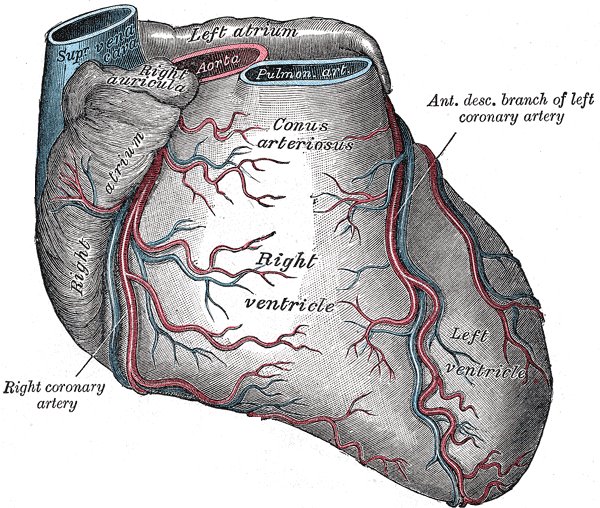
Image source: Gray's Anatomy, 1918, public domain.

Comments from Twitter:

Michael Mirochna, MD @DocRockne:  unfortunately, no evidence they help with OUTCOMES

Long term exposure to air pollution linked to coronary events - BMJ video

You can read the research study at the BMJ website: http://www.bmj.com/content/348/bmj.f7412


Throughout the world particulate air pollution is estimated to cause 3.1 million deaths a year and 22% of disability adjusted life years (DALY) due to ischaemic heart disease. Several cohort studies have reported that long term exposure to air pollution is associated with mortality, in particular cardiovascular mortality.

The ESCAPE Study (European Study of Cohorts for Air Pollution Effects) was conducted between 2008 and 2012 to quantify the associations between exposures and health outcomes. The study design included prospective cohort studies and meta-analysis of the results. The cohorts were in Finland, Sweden, Denmark, Germany, and Italy.

100,000 people were enrolled and followed for 11 years. Participants were free from previous coronary events at baseline.

A 5 μg/m3 increase in estimated annual mean PM2.5 was associated with a 13% increased risk of coronary events, and a 10 μg/m3 increase in estimated annual mean PM10 was associated with a 12% increased risk of coronary events.

Long term exposure to particulate matter is associated with incidence of coronary events.
Coronary stent paper manual: All pages "intentionally" left blank

Coronary stent paper manual: All pages "intentionally" left blank


Video showing a Cordis Coronary Stent Paper Manual: There were no instructions in the manual... just pages "intentionally" left blank.
C-reactive protein (CRP) associated with risk of coronary heart
disease, stroke, vascular mortality, and death from several cancers and
lung disease

C-reactive protein (CRP) associated with risk of coronary heart disease, stroke, vascular mortality, and death from several cancers and lung disease

Associations of C-reactive protein (CRP) concentration with risk of major diseases can best be assessed by long-term prospective follow-up of large numbers of people.

This Lancet meta-analysis included records of 160,309 people without a history of vascular disease from 54 long-term prospective studies.

Risk ratios (RRs) were 1·23 for coronary heart disease; 1·32 for ischaemic stroke; 1·34 for vascular mortality; and 1·34 for non-vascular mortality.

CRP concentration has continuous associations with the risk of:

- coronary heart disease
- ischaemic stroke
- vascular mortality
- death from several cancers and lung disease

The relevance of CRP to such a range of disorders is unclear. Associations with ischaemic vascular disease depend considerably on conventional risk factors and other markers of inflammation.

Is is still a topic of debate is whether CRP has a causal role in the development of cardiovascular disease.

However, even if CRP might not be involved in the causal pathway of atherogenesis and plaque rupture, it may still be a valuable tool in cardiovascular medicine.

In primary prevention, lovastatin therapy was more cost effective in people with increased CRP concentrations.

The JUPITER trial recently showed that, in people with relatively normal LDL cholesterol concentrations and CRP higher than 2 mg/L, rosuvastatin reduced cardiovascular risk. Even if CRP turns out to be not directly causal in cardiovascular disease, it might be useful to identify individuals at cardiovascular risk and to evaluate the efficacy of our preventing and therapeutic interventions.

References:
C-reactive protein concentration and risk of coronary heart disease, stroke, and mortality: an individual participant meta-analysis. The Lancet, Volume 375, Issue 9709, Pages 132 - 140, 9 January 2010.
C-reactive protein and cardiovascular risk: more fuel to the fire. S Matthijs Boekholdt a b, John JP Kastelein b. The Lancet, Volume 375, Issue 9709, Pages 95 - 96, 9 January 2010.
C reactive protein concentration itself is unlikely to be even a modest causal factor in coronary heart disease - BMJ, 2011. http://goo.gl/d5lCH
Image source: C-reactive protein. Wikipedia, GNU Free Documentation License.

3-gram reduction in daily salt intake would decrease coronary heart disease, stroke, and death

The U.S. diet is high in salt, with the majority coming from processed foods. Reducing dietary salt is a potentially important target for the improvement of public health.

Reducing dietary salt by 3 g per day (1200 mg of sodium per day) is projected to reduce the annual number of new cases of CHD by 60,000 to 120,000, stroke by 32,000 to 66,000, and myocardial infarction by 54,000 to 99,000 and to reduce the annual number of deaths from any cause by 44,000 to 92,000. Such an intervention would be more cost-effective than using medications to lower blood pressure in all persons with hypertension.

The cardiovascular benefits of reduced salt intake are on par with the benefits of population-wide reductions in tobacco use, obesity, and cholesterol levels.

References:

Projected Effect of Dietary Salt Reductions on Future Cardiovascular Disease. NEJM, 2010.
http://content.nejm.org/cgi/content/short/362/7/590
Sweat Bees prefer sweaty people because the human diet is so salty that their perspiration is saturated with that essential nutrient. WSJ, 2012.
Image source: Single-serving salt packets. Wikipedia, GNU Free Documentation License.

Increasing Diet Polyunsaturated Fat in Place of Saturated Fat Reduces Risk of Coronary Heart Disease

Reduced saturated fat (SFA) consumption is recommended to decrease coronary heart disease (CHD), but there is an absence of strong supporting evidence from randomized controlled trials (RCTs) of clinical CHD events and few guidelines focus on any specific replacement nutrient. Additionally, some public health groups recommend lowering or limiting polyunsaturated fat (PUFA) consumption, a major potential replacement for SFA.

The overall pooled risk reduction was 19% (RR = 0.81), corresponding to 10% reduced CHD risk (RR = 0.90) for each 5% energy of increased PUFA.

These findings provide evidence that consuming PUFA in place of SFA reduces CHD events in RCTs. This suggests that rather than trying to lower PUFA consumption, a shift toward greater population PUFA consumption in place of SFA would significantly reduce rates of CHD.

References:
Mozaffarian D, Micha R, Wallace S (2010). Effects on Coronary Heart Disease of Increasing Polyunsaturated Fat in Place of Saturated Fat: A Systematic Review and Meta-Analysis of Randomized Controlled Trials. PLoS Med 7(3): e1000252. doi:10.1371/journal.pmed.1000252
The long history of dieting fads: "soap should be eaten for its diuretic properties", wrote a prominent surgeon in 1810. Lancet, 2012.
How We Eat: Analyzing Half a Million Meals - 5 INFOGRAPHICS
Top diets of 2012 - from Cleveland Clinic health blog http://buff.ly/X2I4BJ
Image source: Varieties of meat, Wikipedia, public domain.
People who "drink heavily every so often" are 45% more likely to
develop coronary heart disease

People who "drink heavily every so often" are 45% more likely to develop coronary heart disease

Occasional heavy drinking was defined as having 5 or more standard drinks in a day at least 12 times per year. "Regular" heavy drinkers - those who averaged at least 5 drinks per day, were excluded from the analysis.

In general, moderate drinking - a drink or two per day - is considered a potentially heart-healthy habit. A number of studies have found that moderate drinkers have lower risks of heart disease than teetotalers do.

Research suggests that alcohol can increase "good" HDL cholesterol, has anti-inflammatory effects in the blood vessels and may make the blood less prone to clotting.

On the other hand, regular heavy drinking may increase blood pressure, promote blood clotting and contribute to development of arrhythmias.

References:

Occasional binges may undo alcohol's heart benefits. Reuters, 2010.
Monounsaturated fats found in vegetable oils, nuts and avocados increase "good" HDL cholesterol levels by 12% http://goo.gl/GBQa5
Alcohol literally kills: Gary Moore had 380mg/dL in his blood, Winehouse 416mg/dL when she died surrounded by 3 empty vodka bottles. Telegraph UK, 2012
Image source: OpenClipArt.org, public domain.
A Heart Has Endured 67 Stents and 28 Coronary Angiograms - How Much is
Too Much?

A Heart Has Endured 67 Stents and 28 Coronary Angiograms - How Much is Too Much?

A 56-year-old male with coronary artery disease (CAD) presented with angina, nonspecific electrocardiographic (ECG) changes, and elevated troponins.

Coronary angiography revealed total occlusion of a stent in the circumflex artery, where another was deployed—his 67th stent.

The patient had 28 catheterizations over 10 years, with stents placed in his native coronary arteries as well as in 3 bypass grafts. All stents were placed to relieve his angina, refractory to maximal medical treatment and transmyocardial laser revascularization.

Stents can be a great tool to help revascularization and relieve symptoms; unfortunately, they are prone to thrombosis and restenosis. If they fail while medical management is maximized unsuccessfully, alternative tools are lacking.

This case raises many questions, among them: "How much is too much?"

Clearly, this is not an example of standard of care. Should we be concerned that this case is indicative of a system that has lost its way?

References:

A Heart With 67 Stents. J Am Coll Cardiol, 2010; 56:1605, doi:10.1016/j.jacc.2010.02.077
67 stents, 28 coronary angiograms, and a crippled healthcare system. Eric Topol, 2010.
Image source: Gray's Anatomy, 1918, public domain.

Comments from Facebook and Twitter:

Talk about a full metal jacket! Baby!

One thing's for sure, no surgeon is going to touch him now for bypass. I did note, however, that he still does not have an LV lead for biV pacing, so he might not be done with procedures yet! :)

Surgeons are smart these days, they separate stent struts and graft! There is definite scope for a Combo device .

This case is indicative of system , that is addicted to invasive interventoin I suppose...Nevertheless it's quite interesting.

Not to mention the radiation.
Lipoprotein-associated phospholipase A2 increases risk of coronary
disease

Lipoprotein-associated phospholipase A2 increases risk of coronary disease

Lipoprotein-associated phospholipase A2 (Lp-PLA2), an inflammatory enzyme expressed in atherosclerotic plaques, is a therapeutic target being assessed in trials of vascular disease prevention.

Lp-PLA2 activity and mass each show continuous associations with risk of coronary heart disease, similar in magnitude to that with non-HDL cholesterol or systolic blood pressure.


Lipoprotein structure (chylomicron). Image source: Wikipedia, GNU Free Documentation License.

References: