Showing posts with label treatment. Show all posts

Linaclotide for treatment of constipation - minimally absorbed peptide agonist of guanylate cyclase C receptor

Linaclotide is a minimally absorbed peptide agonist of the guanylate cyclase C receptor. It consists of 14 amino acids. The sequence is:

H–Cys1–Cys2–Glu3–Tyr4–Cys5–Cys6–Asn7–Pro8–Ala9–Cys10–Thr11–Gly12–Cys13–Tyr14–OH

Two randomized, 12-week trials included 1,300 patients with chronic constipation (NEJM, 2011). Patients received either placebo or linaclotide once daily for 12 weeks.

The incidence of adverse events was similar among all study groups, with the exception of diarrhea, which led to discontinuation of treatment in 4.2% of patients in linaclotide groups.

Linaclotide reduced bowel and abdominal symptoms in patients with chronic constipation. Additional studies are needed to evaluate the potential long-term risks of linaclotide in chronic constipation.

References:

Two Randomized Trials of Linaclotide for Chronic Constipation. N Engl J Med 2011; 365:527-536August 11, 2011.

Image source: Colon (anatomy), Wikipedia, public domain.

Depression treatment is as effective in older (over 65) as in younger adults

Depression in later life, traditionally defined as age older than 65, is associated with disability, increased mortality, and poorer outcomes.

Compared to younger adults with depression:

- cognitive and functional impairment and anxiety are more common in older adults

- older adults with depression are at increased risk of suicide

Depression is associated with cognitive impairment and an increased risk of dementia.

A selective serotonin reuptake inhibitor (SSRI) should be the first line pharmacological treatment for depression for most older adults.

Psychological and drug treatment is as effective in older as in younger adults

References:

Depression in older adults. Rodda et al. BMJ, 2011.

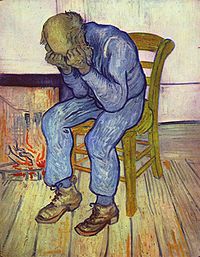
Image source: Vincent van Gogh's 1890 painting At Eternity's Gate. Wikipedia, public domain.

Essential tremor: what are the treatment options?

Essential tremor is a common neurologic problem. It should be differentiated from secondary causes of tremor and Parkinson disease.

Impact of essential tremor

Essential tremor causes motor dysfunction (e.g. a dentist may have to quit his/her job). However, more importantly, the tremor can have a psychological impact on the patient, especially since it usually gets worse in social situations.

Diagnosis

Essential tremor is a clinical diagnosis. A thorough review of the medical history and medication exposures is a good start. Laboratory and imaging tests may be ordered to rule out a secondary cause.

Treatment

The two first-line agents in drug therapy for essential tremor are:

- nonselective beta-blocker propranolol (Inderal)
- antiepileptic primidone (Mysoline)

They can be used alone or in combination.

Severe, resistant, or atypical cases should be referred to a specialist. Botulinum toxin injection and deep brain stimulation are reserved for resistant tremor or for patients who do not tolerate drug therapy.

Dr. Young from Swedish Medical Center discusses some of the new treatments for essential tremor in this video:


References:

Essential tremor: Choosing the right management plan for your patient. CCJM, 2011.

New treatment for dry eyes: "LipiFlow" uses heat and pressure to open blocked eyelid oil glands

The Meibomian glands (or tarsal glands) are sebaceous glands at the rim of the eyelids, responsible for the supply of meibum, an oily substance that prevents evaporation of the eye's tear film. They prevent tear spillage onto the cheek, trapping tears between the oiled edge and eyeball, and make the closed lids airtight. There are approximately 50 glands on the upper eyelids and 25 glands on the lower eyelids. The glands are named after Heinrich Meibom (1638–1700), a German physician (source: Wikipedia).

The LipiFlow Thermal Pulsation System uses heat and pressure to open blockages of the eyelid (Meibomian) glands. The treatment was approved by the FDA in 2011. Here is more information: http://lipiflow.com

Here is a Mayo Clinic video about the procedure:

Internet Addiction documentary shows Chinese boot-camp-style treatment

China's Web Junkies - Internet Addiction Documentary by the NYTimes about a Chinese boot-camp-style treatment center for young men "addicted" to the Internet. Read the story here: http://nyti.ms/1moCt4h


Compulsive Internet use has been categorized as a mental health issue in many countries, including the United States, but China was among the first to label “Internet addiction” a clinical disorder. This video shows the inner workings of a rehabilitation center where Chinese teenagers are “deprogrammed.”

There are now hundreds of treatment programs throughout China and South Korea. The first inpatient Internet addiction program in the United States recently opened in Pennsylvania. Here is the link to the CNN story about the program.

Is Internet addiction real?

According to The New York Times, Internet addiction affects 10 percent of the web users in the U.S. The so-called "Onlineaholics" spend endless hours surfing the web to the point that their Internet activity disturbs their daily life.

 A growing number of therapists are treating web addicts with the 12-step programs, used to treat chemical addictions. The condition is not officially recognized as a psychiatric disorder and insurance companies do not pay for treatment.

 The University of Massachusetts, Lowell has more information on the Internet addiction disorder: Take an Internet Addiction Survey Online

Online social networking may 'harm health' due to reduction of face-to-face contact

Aric Sigman pubslished his "warning" in Biologist, the journal of the Institute of Biology (click here for the original PDF). From BBC:

  • Lack of face-to-face networking could alter the way genes work, upset immune responses, hormone levels, the function of arteries, and influence mental performance

  • Number of hours people spend interacting face-to-face has fallen dramatically since 1987, as the use of electronic media has increased

  • "One of the most pronounced changes in the daily habits of British citizens is a reduction in the number of minutes per day that they interact with another human being," he said.

  • "In less than two decades, the number of people saying there is no-one with whom they discuss important matters nearly tripled."

"Netiquette" and married couples

From the study:

Men are more associated with activities that have been associated with internet addiction. Men usually take more risks in their online activity.

Women are more likely to have lower computer self-efficacy and less positive internet attitudes. Women are more aware of privacy and economic risks in online transactions.

6% of married internet users have met their partner online.

In 30% of the couples at least one person checked their partner’s emails or read their partner’s SMS messages without them knowing. In 20% of the couples at least one the partners had checked their spouse’s browser history.

References:

Hooked on the Web: Help Is on the Way. NYTimes, published: December 1, 2005
Is Internet addiction real? American Psychological Association
Netiquette within married couples
Helsper, E., & Whitty, M. (2010). Netiquette within married couples: Agreement about acceptable online behavior and surveillance between partners Computers in Human Behavior DOI: 10.1016/j.chb.2010.02.006
Online networking 'harms health.' BBC.

Controversies in COPD treatment

Chronic obstructive pulmonary disease (COPD) is a chronic disorder with high mortality rates (one of the top 5 causes of death).

COPD is expected to rise to the third leading cause of death worldwide by 2030. More than 25% of COPD patients have never been smokers.

Some important controversies in COPD management still exist:

- The classic way to define COPD has been based on spirometric criteria, but more relevant diagnostic methods are needed that can be used to describe COPD severity and comorbidity

- Initiation of interventions earlier in the natural history of the disease to slow disease progression is debatable

- There are controversies about the role of inhaled corticosteroids (ICS) in the management of COPD

- Long-term antibiotics for prevention of exacerbation have had a resurgence in interest

New drugs are urgently needed for management of COPD exacerbation.

COPD is a complex disease and consists of several phenotypes that in future would guide its management.


Asthma Inhalers (click to enlarge the image). Advair and Symbicort are FDA-approved for treatment of COPD in the U.S.


COPD Action Plan - National Jewish - YouTube http://buff.ly/1pwyHZL

References:

Controversies in treatment of chronic obstructive pulmonary disease. Prof Klaus F Rabe MD a , Jadwiga A Wedzicha MD b. The Lancet, Volume 378, Issue 9795, Pages 1038 - 1047, 10 September 2011.

New insights into the immunology of chronic obstructive pulmonary disease. The Lancet, Volume 378, Issue 9795, Pages 1015 - 1026, 10 September 2011.

COPD—more vigorous research needed. The Lancet, Volume 378, Issue 9795, Page 962, 10 September 2011.

Diagnosis and Management of COPD - Current Guidelines

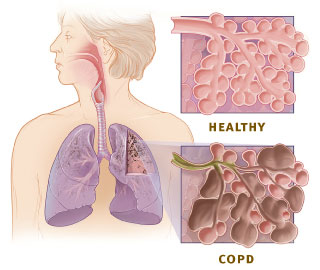
Image source: Enlarged view of lung tissue showing the difference between healthy lung and COPD, Wikipedia, public domain.

Treatment Options for Osteoporosis

I selected a few excerpts from a patient information review in the New York Times:

What is osteoporosis

Osteoporosis is defined as having a bone mineral density T score of minus 2.5 or lower. Lesser degrees of bone loss, known as osteopenia, may not benefit from drug therapy.

Bisphosphonates

The first drug licensed to counter osteoporosis, Fosamax, is now available generically as alendronate, which can be taken once a day or, at a higher dose, once a week. A reluctance on the part of many patients to adhere to a daily or weekly regimen led to the development of Boniva (ibandronate), administered by an intravenous injection every three months. To further simplify the frequency of administration, Reclast (zoledronic acid) was developed as a once-a-year intravenous treatment.

Actonel, alendronate and Boniva have been shown in three-year studies of postmenopausal women to reduce vertebral fractures by 41-50%, and less for other kinds of fractures.

A three-year study of Reclast found it to be somewhat more effective, with a 70 percent reduction in vertebral fractures, 41 percent in hip fractures and 25 percent in other fractures in postmenopausal women with osteoporosis.

Side Effects of Bisphosphonates

In a large study of Reclast, there was also a worrisome increase in atrial fibrillation — an irregular heart rhythm — not known to occur with other bisphosphonates.

Low-trauma fracture with a delay in healing or complete failure may occur after many years on bisphosphonates.

These side effects have prompted a warning that after five years on bisphosphonates, people should take a break from the drugs for at least a year.

Evista (raloxifene)

Evista (raloxifene) has an added advantage of reducing the risk of breast cancer, but the disadvantage of increasing the risk of deep vein blood clots.

Calcitonin

Somewhat less effective at reducing vertebral fractures is calcitonin, a naturally occurring hormone sold as Fortical and Miacalcin.

Forteo (teriparatide)

Finally, there is the bone-building drug Forteo (teriparatide), which must be self-injected once a day. This human parathyroid hormone can reduce vertebral fractures by 65 percent and other fractures by 53 percent within 18 months in patients with osteoporosis.

Denosumab

Under study is an entirely new bone drug, denosumab, a human monoclonal antibody. The drug inhibits a receptor that activates cells called osteoclasts that break down bone. In a large three-year study, denosumab, given by injection every six months to postmenopausal women with osteoporosis, reduced vertebral fractures by 68 percent and hip fractures by 40 percent.

References:
Options for Bone Loss, but No Magic Pill. NYT, January 4, 2010.
Denosumab is a monoclonal antibody that reduces fractures in osteoporosis
Image source: Flickr, Creative Commons license.
30% of doctors have changed a patient's treatment as a result of an
Internet search

30% of doctors have changed a patient's treatment as a result of an Internet search

From AMedNews:

86% of physicians use Internet to access health information. Why not 100%?

72% of physicians start their health information search with a search engine, 92% of those using Google.

A third of doctors have changed a patient's treatment as a result of an Internet search.

Consistent with other search engine research findings that users tend to click the most prominent links, 92% of physician searchers clicked on the links appearing at the top of the page, 46% clicked those in the middle of the page, and 24% clicked on those on the bottom. Also, 8% clicked on sponsored links.

References:
86% of physicians use Internet to access health information. AMedNews.
Image source: Doctors Using Google by Philipp Lenssen, used with permission.